
Kia EV6: Maintenance
Contents:
- Motor Room Compartment
- Maintenance Services
- Owner Maintenance
- Scheduled Maintenance Service
- Explanation of Scheduled Maintenance Items
- Coolant
- Brake Fluid
- Washer Fluid
- Climate Control Air Filter
- Wiper Blades
- Type A: (if equipped)
- 12V Battery
- Tires and Wheels
- Dedicated Remover Storage Position
- 1. Manufacturer or Brand Identification
- Fuses
- Multi Fuse
- Driver side fuse panel
- Light bulbs
- Appearance care
- Exterior general caution
- Interior general precautions
Motor Room Compartment
Open the hood to access the motor room compartment of the Kia EV6.
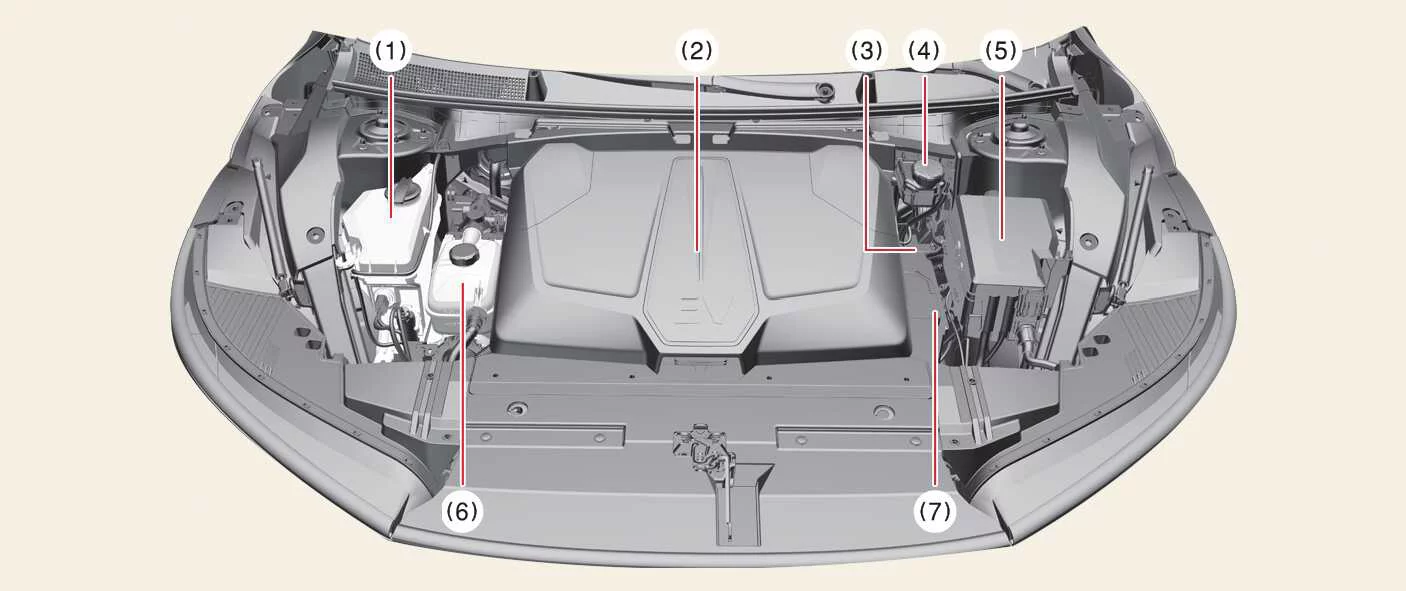
The actual motor compartment configuration of your Kia EV6 may vary slightly depending on vehicle specification and market version.
-
Coolant reservoir
-
Brake fluid reservoir
-
Windshield washer fluid reservoir
-
Fuse box
-
Negative battery terminal (-)
-
Positive battery terminal (+)
-
Front trunk (frunk)
Regular inspection of these service points helps maintain the performance, reliability, and long-term durability of the Kia EV6 electric vehicle system.
Maintenance Services
Always exercise caution when carrying out inspection, maintenance, or service procedures on your Kia EV6. Proper maintenance practices help preserve vehicle performance, reliability, and safety while reducing the risk of personal injury or unnecessary vehicle damage.
If you are uncertain about any maintenance operation or inspection requirement, it is strongly recommended that the work be performed by an authorized Kia dealer.
Authorized Kia dealerships employ factory-trained technicians who are familiar with the advanced systems used in the Kia EV6 and utilize genuine Kia replacement parts specifically designed for your vehicle.
Professional servicing performed according to Kia standards helps maintain the efficiency, durability, and long-term value of your Kia EV6. For expert technical support and quality workmanship, always consult an authorized Kia dealer.
Failure to perform maintenance correctly, completely, or at the recommended intervals may lead to reduced vehicle performance, component damage, unexpected malfunctions, accidents, or personal injury.
Owner's Responsibility
NOTE
Maintaining accurate service records and ensuring that scheduled maintenance is completed on time are the responsibility of the Kia EV6 owner.
Keep all receipts, service invoices, maintenance logs, and inspection records showing that the required maintenance procedures have been performed according to the recommended Kia EV6 maintenance schedule.
These records may be required to verify compliance with warranty obligations and scheduled maintenance requirements.
Comprehensive warranty coverage information can be found in the Warranty & Consumer Information Manual supplied with your Kia EV6.
Repairs, adjustments, or component replacements that become necessary because of neglected maintenance, improper servicing, or failure to follow the recommended maintenance schedule are generally not covered under warranty.
To ensure optimal operation of your Kia EV6, have all maintenance and repair work performed by an authorized Kia dealer whenever possible.
Authorized Kia service facilities maintain strict quality-control standards and receive ongoing technical training and manufacturer support to provide owners with a consistently high level of customer satisfaction.
NOTE
NHTSA Safety Corrosion Advisory
The National Highway Traffic Safety Administration (NHTSA) has issued guidance regarding the risks associated with underbody corrosion on all vehicle brands, including electric vehicles such as the Kia EV6.
To help protect your vehicle from corrosion-related damage and maintain long-term structural integrity, follow these recommendations:
-
Wash the underside of your Kia EV6 regularly during winter months and after driving on roads treated with salt, de-icing chemicals, or other corrosive substances.
-
Perform a thorough underbody cleaning at the conclusion of each winter season to remove accumulated contaminants.
-
Arrange for an annual corrosion inspection by a qualified automotive technician or an approved vehicle inspection facility.
-
Schedule an immediate inspection if you notice corrosion, rust scaling, flaking metal, fluid leaks, unusual suspension noises, reduced braking performance, steering abnormalities, or deteriorating vehicle control characteristics.
-
NHTSA further recommends that once a vehicle reaches approximately seven years of age, these corrosion-prevention measures become even more important for maintaining long-term safety.
Owner Maintenance Precautions
Improper, incomplete, or incorrectly performed maintenance procedures may create vehicle operating issues and potentially compromise the safety of your Kia EV6.
This section provides guidance only for basic maintenance tasks that can reasonably be performed by the vehicle owner using standard tools and procedures.
As noted throughout the Kia EV6 owner's manual, certain inspections, adjustments, diagnostics, and repair operations require specialized equipment, manufacturer training, and dedicated service tools available only through authorized Kia service facilities.
NOTE
Improper maintenance performed by the owner during the warranty period may affect warranty coverage. For complete details, consult the Warranty & Consumer Information Manual provided with your Kia EV6.
If you are unsure about any inspection, repair, adjustment, or maintenance procedure, have the work carried out by an authorized Kia dealer.
WARNING
Maintenance Safety Procedures
Do not wear jewelry, watches, rings, bracelets, necklaces, neckties, scarves, loose sleeves, or other loose-fitting clothing while working inside the motor compartment of the Kia EV6.
If maintenance must be performed while the vehicle is in READY mode, rotating components and cooling fans may operate unexpectedly. Loose clothing or accessories can become entangled and cause serious injury.
Before approaching moving components, remove all jewelry and secure any loose clothing to reduce the risk of accidents.
WARNING
Hot Metal Components
Do not touch metal components, structural braces, support bars, cooling-system components, or other metallic parts while the Kia EV6 is operating or immediately after it has been driven.
Many components may remain extremely hot for an extended period and can cause serious burns or other injuries.
Switch the Kia EV6 OFF completely and allow sufficient cooling time before beginning any inspection, maintenance, or repair procedure.
WARNING
Electric Vehicle Safety
The Kia EV6 contains high-voltage electrical systems that should only be serviced by properly trained personnel. Never attempt to disassemble, modify, or repair high-voltage components unless specifically authorized and qualified to do so.
Owner Maintenance
The following inspection and maintenance procedures for the Kia EV6 should be carried out either by the vehicle owner or by an authorized Kia dealer at the recommended intervals. Performing these checks regularly helps ensure safe operation, dependable performance, and long-term reliability of your Kia EV6.
If any abnormal condition, unusual noise, warning message, leak, or irregular vehicle behavior is detected, report it to an authorized Kia dealer as soon as possible for professional diagnosis and repair.
Please note that routine owner inspections and maintenance operations are generally not covered by the vehicle warranty. Charges for labor, replacement components, fluids, and lubricants may apply when these services are performed by a service facility.
When You Stop for Charging
-
Inspect the coolant level inside the coolant reservoir and verify that it remains within the recommended operating range for the Kia EV6.
-
Check the windshield washer fluid reservoir and refill it if necessary.
-
Take a quick visual look around the Kia EV6 for signs of leaks, tire damage, or unusual wear.
WARNING
Exercise extreme caution when inspecting coolant levels while the motor compartment is hot. Pressurized coolant may escape unexpectedly and cause serious burns, eye injuries, or other bodily harm.
While Operating Your Vehicle:
-
Monitor the steering wheel for unusual vibration, increased steering effort, excessive play, looseness, or changes in steering-center position.
-
Observe whether the Kia EV6 consistently drifts, pulls, or veers toward one side when driving on a smooth and level roadway.
-
When braking, listen for unusual noises and pay attention to increased pedal travel, brake vibration, pulling, or changes in braking performance.
-
If slipping, hesitation, abnormal gear-selection behavior, or transmission-related issues occur, have the Kia EV6 inspected by an authorized Kia dealer immediately.
-
Verify proper operation of the P (Park) function and ensure the vehicle remains securely parked when selected.
-
Periodically inspect the area beneath the Kia EV6 for signs of fluid leakage. Small amounts of water dripping from the air-conditioning system during or after operation are considered normal.
-
Remain alert for warning lights, unusual smells, vibrations, or unexpected changes in vehicle performance.
At Least Monthly:
-
Check the coolant level in the coolant reservoir and top up if required according to Kia specifications.
-
Inspect the operation of all exterior lighting systems, including headlights, daytime running lights, stop lamps, tail lamps, turn signals, reverse lamps, and hazard warning flashers.
-
Measure and adjust tire inflation pressures, including the spare tire if equipped. Also inspect all tires for damage, cuts, punctures, uneven wear, or excessive tread wear.
-
Check wheel lug nuts for looseness and verify proper wheel security.
-
Inspect windshield condition and verify that no significant cracks or damage are present.
At Least Twice Each Year:
-
Check windshield washer operation and windshield wiper performance. Clean the wiper blades using a soft cloth moistened with washer fluid.
-
Verify proper headlamp alignment to maintain optimum nighttime visibility and avoid glare for other road users.
-
Inspect seat belts, including lap and shoulder sections, for wear, damage, fraying, proper retraction, and normal operation.
-
Inspect door seals and weatherstripping for signs of aging, cracking, or deterioration.
At Least Once Each Year:
-
Clean all body drain holes and door drain openings to ensure proper water drainage.
-
Lubricate door hinges and inspect hood hinges for smooth operation.
-
Lubricate door locks, hood latches, and related locking mechanisms.
-
Apply protective treatment to door weather seals and rubber strips to maintain flexibility.
-
Inspect the climate-control and air-conditioning systems for proper performance.
-
Inspect and lubricate reducer-control linkages and associated components where applicable.
-
Clean the 12-volt battery housing and battery terminals to help prevent corrosion.
-
Check the brake fluid level and verify that it remains within the specified range.
-
Inspect visible suspension and steering components for signs of wear or damage.
Scheduled Maintenance Service
Follow the Normal Maintenance Schedule for your Kia EV6 if the vehicle is operated under typical driving conditions and none of the severe-use conditions listed below apply.
If the Kia EV6 is routinely driven under one or more of the following conditions, the Severe Usage Maintenance Schedule should be followed instead.
-
Frequent short-distance driving of less than 5 miles (8 km) under normal temperatures or less than 10 miles (16 km) in freezing conditions.
-
Regular driving on rough, dusty, muddy, gravel, unpaved, or salt-treated roads.
-
Operation in regions where road salt, corrosive materials, or extremely cold temperatures are common.
-
Driving in environments with heavy airborne dust.
-
Driving in severe traffic congestion with ambient temperatures above 90°F (32°C) while consuming more than 50% of available electric energy.
-
Repeated travel on steep uphill, downhill, or mountainous routes.
-
Towing a trailer or operating with a camper, cargo carrier, or roof rack.
-
Commercial use of the Kia EV6, including taxi service, patrol service, delivery work, or frequent towing operations.
-
Frequent high-speed driving or repeated rapid acceleration and deceleration.
-
Continuous stop-and-go driving in urban traffic conditions.
If any of the above operating conditions apply, inspections, replacements, fluid services, and maintenance operations should be performed more frequently than those listed in the normal schedule.
NOTE
For Kia EV6 vehicles exceeding 10 years of age or 100,000 miles (150,000 km), Kia recommends following the Severe Usage Maintenance Schedule regardless of normal operating conditions to help preserve long-term reliability and performance.
Normal Maintenance Schedule
I: Inspect and, if necessary, adjust, repair, clean, or replace.
R: Replace or renew the component or fluid.
Maintenance Under Severe Usage Conditions
The following components on the Kia EV6 may require more frequent inspection or replacement when the vehicle is operated under severe conditions:
-
Reducer fluid.
-
Drive shafts and protective boots.
-
Climate-control air filter.
-
Brake discs, brake pads, and calipers.
-
Steering gear rack, steering linkage components, and protective boots.
-
Suspension ball joints and suspension-related hardware.
Regular maintenance is one of the most effective ways to preserve the safety, efficiency, driving range, and overall reliability of your Kia EV6 throughout its service life.
Explanation of Scheduled Maintenance Items
The following components of the Kia EV6 require periodic inspection, maintenance, or replacement according to the recommended service schedule. Performing these maintenance procedures on time helps ensure maximum reliability, efficiency, safety, and long-term durability of your Kia EV6 electric vehicle.
Reducer Fluid
The reducer fluid should be inspected at the intervals specified in the maintenance schedule. Regular inspections help protect drivetrain components and ensure smooth, efficient operation of the Kia EV6 electric powertrain. If contamination, leakage, or deterioration is detected, corrective service should be performed immediately.
Cooling System
Inspect all cooling system components, including the radiator, coolant reservoir, hoses, hose connections, coolant 3-way valve, chiller, and related fittings for signs of leakage, wear, deterioration, or physical damage. Any defective component should be replaced promptly to maintain proper thermal management of the Kia EV6.
Coolant
Replace the coolant according to the intervals outlined in the maintenance schedule. Proper coolant maintenance helps maintain the operating temperature of the battery system, electric motor, and power electronics. Always use the coolant specified for the Kia EV6 to ensure optimal cooling performance and component protection.
Brake Hoses and Lines
Visually inspect all brake hoses, brake pipes, and hydraulic connections for improper installation, abrasion, corrosion, cracks, deterioration, leakage, or other signs of damage. Replace any worn or damaged components immediately to preserve safe braking performance.
NOTE
NHTSA Safety Corrosion Alert
The National Highway Traffic Safety Administration (NHTSA) advises vehicle owners of all brands, including Kia EV6 owners, to maintain their brake systems properly in order to prevent corrosion-related failures caused by winter road salt and de-icing chemicals.
Although severe corrosion problems often become visible only after several years of operation, the corrosion process begins from the first exposure to salt-treated roads. Therefore, preventative maintenance should start immediately.
NHTSA recommends the following measures:
-
Wash the underside of your Kia EV6 regularly during winter and perform a thorough cleaning after the winter season to remove accumulated road salt and chemical residues.
-
Monitor the brake system through regular professional inspections and watch for signs such as fluid loss, visible leaks, reduced braking performance, or a soft brake pedal.
-
If severe corrosion causes scaling, flaking, or structural deterioration of brake components, replace the complete brake pipe assembly immediately.
Brake Fluid
Inspect the brake fluid level in the reservoir regularly. The fluid level should remain between the MIN and MAX markings located on the reservoir housing.
Use only hydraulic brake fluid that meets the DOT 4 specification. Maintaining the proper brake fluid level is essential for smooth and consistent braking performance in the Kia EV6.
Brake Discs, Pads and Calipers
Inspect brake pads for excessive wear, brake discs for wear, scoring, runout, or damage, and calipers for fluid leaks or abnormal operation. Timely replacement of worn brake components helps ensure safe and predictable braking performance.
Suspension Mounting Bolts
Inspect suspension mounting points and fasteners for looseness, corrosion, wear, or damage. Retighten all suspension connections to the specified torque values when necessary.
Steering Gear Box, Linkage, Boots, and Lower Arm Ball Joint
With the Kia EV6 parked safely and switched off, inspect the steering wheel for excessive free play or abnormal movement.
Check steering linkages for bending, wear, looseness, or damage. Inspect dust boots and ball joints for cracks, deterioration, grease leakage, or other defects. Replace any damaged components immediately.
Drive Shafts and Boots
Inspect drive shafts, protective boots, and retaining clamps for cracks, deterioration, grease leakage, or physical damage. Replace damaged components and replenish lubrication if necessary to maintain reliable drivetrain operation.
Air Conditioning Refrigerant
Inspect all air-conditioning lines, fittings, seals, and connections for leakage, wear, or damage. Proper refrigerant levels help maintain effective cabin cooling and support the thermal-management systems used by the Kia EV6.
Coolant
The high-pressure cooling system of the Kia EV6 utilizes a reservoir filled with year-round antifreeze coolant. The system is filled at the factory using coolant specifically designed for electric vehicle applications.
Check coolant condition, antifreeze protection, and coolant level at least once every year, preferably before winter, and before driving the Kia EV6 in colder climates.
WARNING
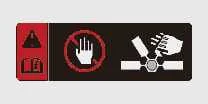 The
electric cooling fan is controlled automatically according to coolant temperature, refrigerant pressure, and
vehicle operating conditions. The fan may begin operating even when the Kia EV6 is switched off.
The
electric cooling fan is controlled automatically according to coolant temperature, refrigerant pressure, and
vehicle operating conditions. The fan may begin operating even when the Kia EV6 is switched off.
Exercise extreme caution whenever working near the cooling fan. Rotating fan blades may cause serious personal injury. As coolant temperature decreases, the fan will automatically stop. This is a normal operating condition.
Inspect the condition of all cooling-system hoses and verify that every connection remains secure and leak-free.
|
Replace any hose that is swollen, hardened, cracked, leaking, or otherwise deteriorated.
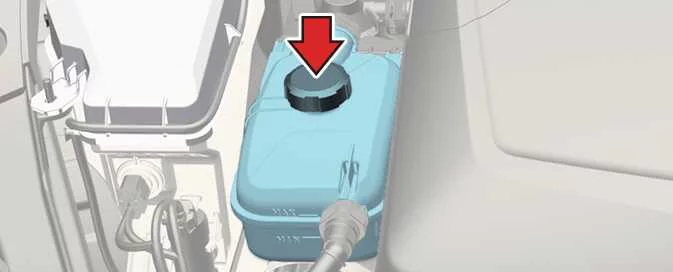
When the motor compartment is cool, the coolant level should remain between the F (MAX) and L (MIN) markings on the coolant reservoir.
If the coolant level in the Kia EV6 reservoir is low, have the vehicle inspected by an authorized Kia dealer. Use only the designated coolant and coolant water approved for Kia electric vehicles. Using incorrect coolant, antifreeze, or water may damage the cooling system and reduce vehicle performance.
WARNING
Use caution when inspecting coolant levels while the motor compartment is hot. Pressurized coolant may escape from the reservoir opening and cause severe burns, eye injuries, or other serious injuries.
Brake Fluid ➤
Washer Fluid ➤
Climate Control Air Filter ➤
Wiper Blades ➤
Type A: (if equipped)
-
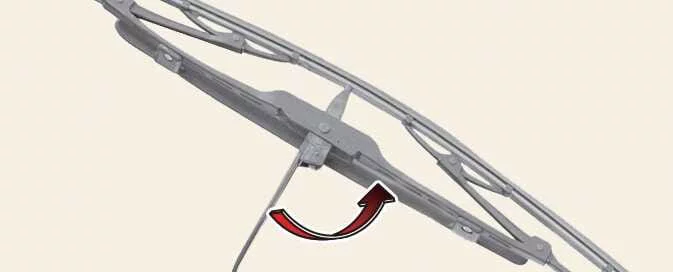
Carefully raise the wiper arm of the Kia EV6 and rotate the wiper blade assembly until the plastic locking clip becomes fully visible and accessible.
CAUTION
Wiper Arms
-
Do not allow the wiper arm to snap back against the windshield. The impact may crack, chip, or otherwise damage the glass surface of your Kia EV6.
-
Do not pull the wiper arm excessively forward, as this may damage the hood edge or paint finish.
-
-
Press and compress the locking clip, then carefully slide the wiper blade assembly downward to release it from the arm.
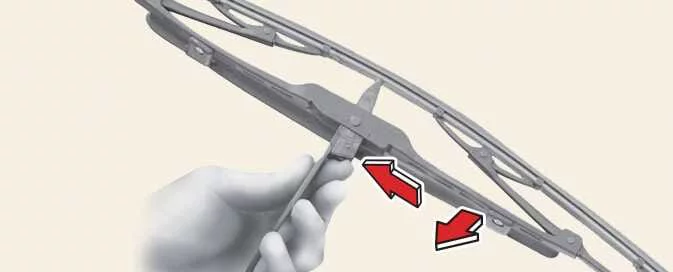
-
Lift the blade assembly away from the wiper arm and remove it completely from the Kia EV6.
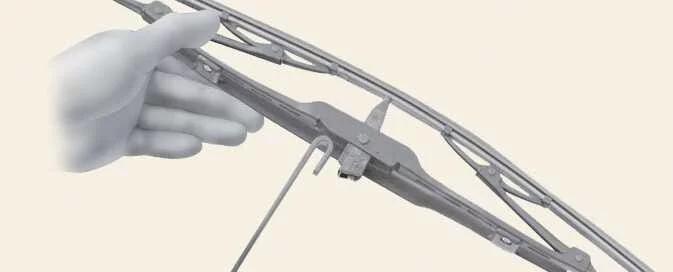
-
Install the replacement wiper blade assembly by performing the removal procedure in reverse order. Verify that the blade is securely locked into place before returning the wiper arm to the windshield.
Type B: (if equipped)
-
Lift the windshield wiper arm away from the glass surface.
-
Raise the wiper blade retaining clip (1), then pull the blade assembly downward and remove it from the arm (2).
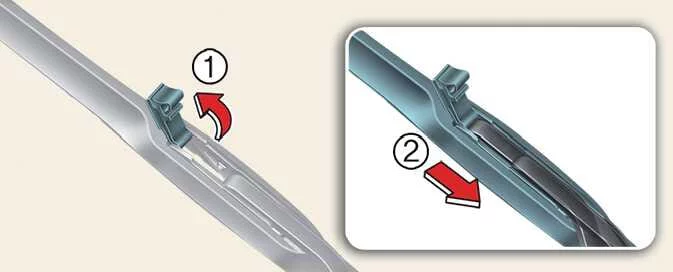
-
Install the new wiper blade assembly and ensure it locks securely onto the wiper arm.
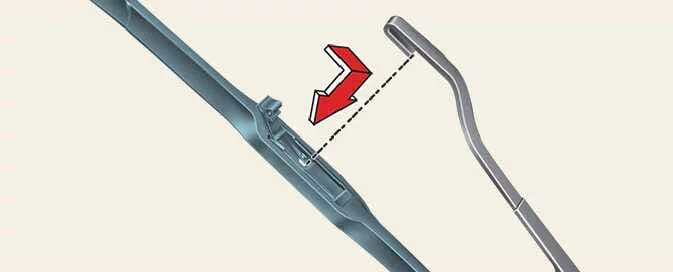
-
Carefully return the wiper arm to its resting position against the windshield.
-
Switch the EV button to the POWER ON position. The wiper arms of the Kia EV6 will automatically return to their normal operating position.
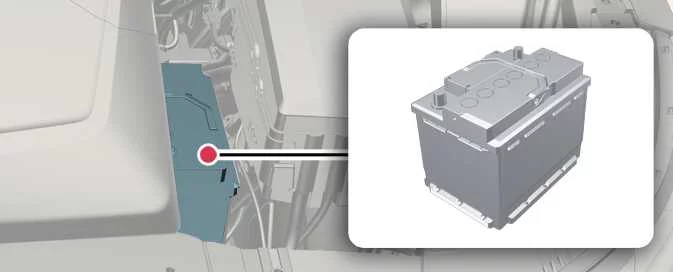
12V Battery
The 12V battery installed in the Kia EV6 supplies power to numerous electrical systems, control modules, convenience features, lighting circuits, and vehicle electronics.
For Best Battery Service
|
-
Ensure the battery remains securely mounted at all times.
-
Keep the top surface of the battery clean, dry, and free from contamination.
-
Keep battery terminals and cable connections clean, tight, and protected with petroleum jelly or terminal grease.
-
Immediately neutralize and rinse any spilled electrolyte using a mixture of water and baking soda.
-
If the Kia EV6 will remain unused for an extended period, disconnect the battery cables to help prevent battery discharge.
WARNING
Risk of Explosion
 Keep cigarettes, open flames, sparks, and
ignition
sources away from the battery.
Keep cigarettes, open flames, sparks, and
ignition
sources away from the battery.
 The battery generates hydrogen gas, which is highly
flammable and may explode if exposed to sparks or flames.
The battery generates hydrogen gas, which is highly
flammable and may explode if exposed to sparks or flames.
 Keep batteries away from children. Battery acid and
electrolyte are highly corrosive and may cause severe injuries or damage to clothing and painted surfaces.
Keep batteries away from children. Battery acid and
electrolyte are highly corrosive and may cause severe injuries or damage to clothing and painted surfaces.
 Always wear protective eyewear when
charging,
servicing, or working near the battery. Ensure adequate ventilation when working indoors.
Always wear protective eyewear when
charging,
servicing, or working near the battery. Ensure adequate ventilation when working indoors.
 Read and follow all battery-handling instructions
carefully
before beginning any maintenance procedure.
Read and follow all battery-handling instructions
carefully
before beginning any maintenance procedure.
 If electrolyte enters the eyes, flush
immediately
with clean water for at least 15 minutes and seek emergency medical assistance. If electrolyte contacts
skin,
wash thoroughly and obtain medical attention if irritation persists.
If electrolyte enters the eyes, flush
immediately
with clean water for at least 15 minutes and seek emergency medical assistance. If electrolyte contacts
skin,
wash thoroughly and obtain medical attention if irritation persists.
 Improper disposal of batteries may harm the
environment and human health. Dispose of batteries according to local regulations.
Improper disposal of batteries may harm the
environment and human health. Dispose of batteries according to local regulations.
 The battery contains lead and other recyclable
materials. Return used batteries to an authorized Kia dealer or approved recycling facility.
The battery contains lead and other recyclable
materials. Return used batteries to an authorized Kia dealer or approved recycling facility.
WARNING
Risk of Electrocution
Never touch electrical motor components while the Kia EV6 is operating. High-voltage systems can cause severe injury, electric shock, or death.
NOTE
Connecting unauthorized electronic accessories to the battery may increase battery drain and shorten battery life. Use only approved equipment designed for the Kia EV6.
WARNING
Recharging Battery
Never attempt to recharge the battery while the battery cables remain connected to the vehicle electrical system.
WARNING
California Proposition 65
Battery terminals, posts, and related accessories contain lead and lead compounds recognized by the State of California as chemicals that may cause cancer, birth defects, and reproductive harm. Wash hands thoroughly after handling battery components.
Battery Recharging
Your Kia EV6 is equipped with a maintenance-free calcium-based 12V battery designed for dependable long-term operation.
-
If the battery becomes discharged, recharge it using a suitable battery charger or operate the Kia EV6 for at least 60 minutes to allow the battery-management system to restore charge.
Observe the following precautions whenever recharging the battery:
-
Remove the battery from the vehicle and place it in a well-ventilated area whenever possible.
-
Keep cigarettes, sparks, flames, and ignition sources away from the battery.
-
Monitor the battery during charging. Stop charging or reduce the charging rate if excessive gassing occurs or if electrolyte temperature exceeds 120°F (49°C).
-
Always wear eye protection while checking or charging the battery.
-
Disconnect the charger using the following sequence:
-
Turn OFF the battery charger.
-
Disconnect the negative charger clamp from the negative battery terminal.
-
Disconnect the positive charger clamp from the positive battery terminal.
-
-
Before servicing or charging the battery, switch off all electrical accessories and ensure the Kia EV6 is completely shut down.
-
When disconnecting the battery, remove the negative cable first and reconnect it last.
Reset Items
After the battery has been disconnected or completely discharged, several systems in the Kia EV6 may require reinitialization or resetting.
-
Automatic window up/down function (refer to Window Opening and Closing).
-
Trip computer data and settings.
-
Climate control system settings (refer to Automatic Climate Control System).
After reconnecting the battery, verify that all vehicle systems operate normally and reconfigure any personalized settings as required.
Tires and Wheels ➤
Dedicated Remover Storage Position ➤
1. Manufacturer or Brand Identification ➤
Fuses ➤
Multi Fuse ➤
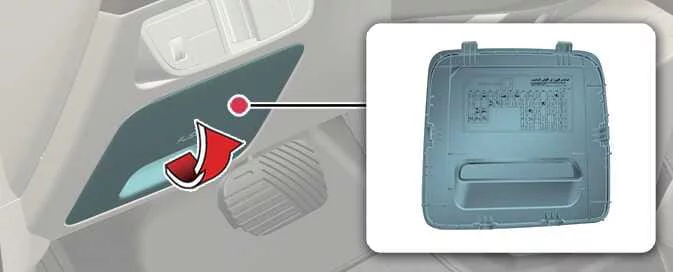
Driver side fuse panel
|
NOTE
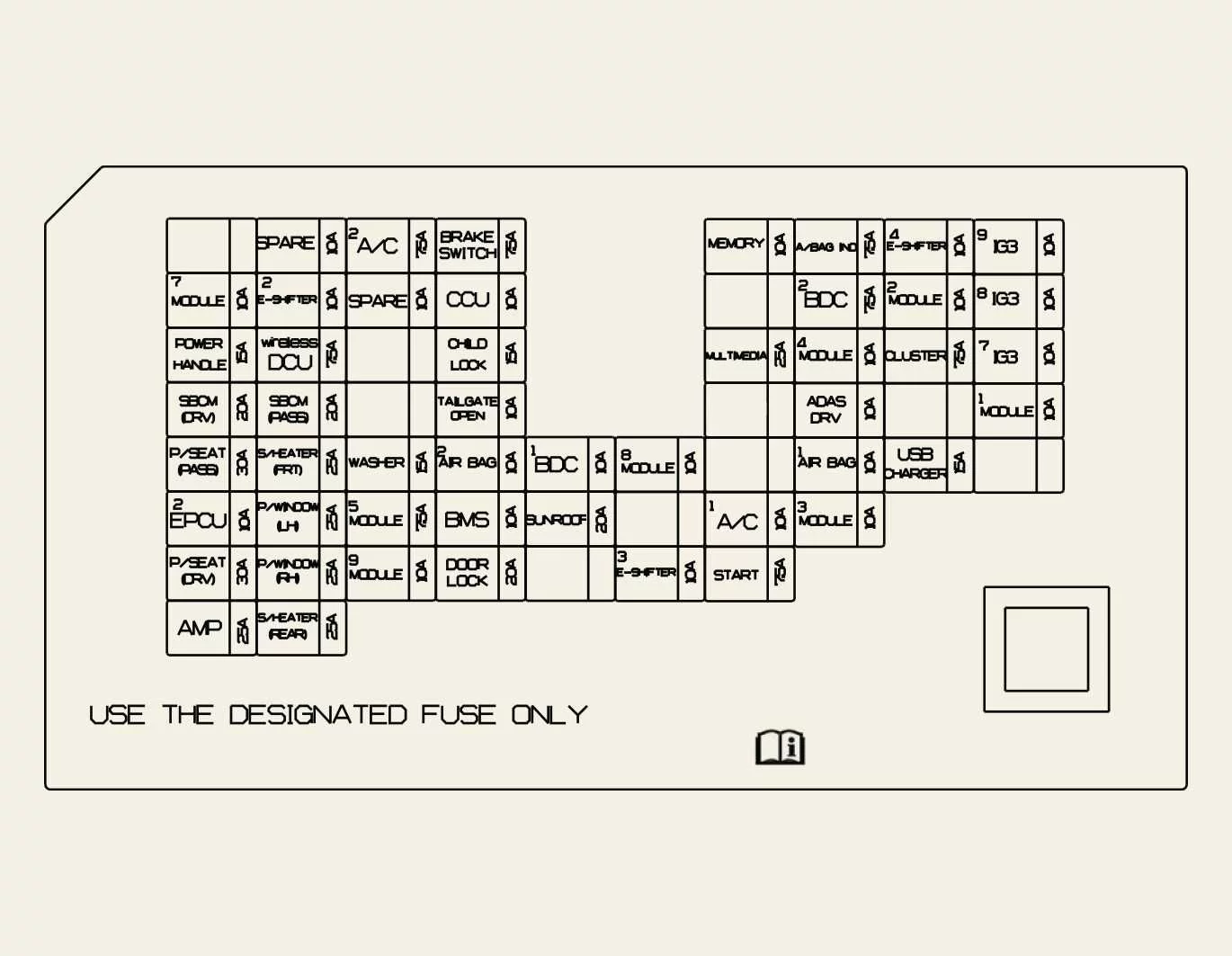
Not all fuse panel descriptions in this manual may apply to your vehicle. It is accurate at the time of printing. When you inspect the fuse panel in your vehicle, refer to the fuse panel label on the inside of the fuse cover. This diagram will provide you with the specific information for your vehicles.
|
Fuse Name |
Fuse Rating |
Circuit Protected |
|---|---|---|
|
|
15A |
Child Lock Relay, Child Unlock Relay |
|
|
20A |
AFCU |
|
|
7.5A |
Overhead Console |
|
|
10A |
ADP, Head-Up Display, ADS Unit |
|
|
7.5A |
VCU, BDC |
|
|
15A |
Liftgate Latch |
|
|
10A |
Rear Inverter |
|
|
7.5A |
Multifunction Switch, BDC, Stop Lamp Switch, Driver Door Module |
|
|
7.5A |
Head-Up Display, Instrument Cluster |
|
|
10A |
cCNC, FATC, INCAR SNSR, PTC |
|
|
10A |
BMS, Rear Inverter |
|
|
10A |
Driver/Passenger Door Outside Handle |
|
|
10A |
Driver/Passenger Power Seat Module, Driver/Passenger Manual Seat Switch |
|
|
20A |
Front Air Ventilation Seat Control Module, Front Seat Warmer Control Module |
|
|
15A |
Multifunction Switch |
|
|
7.5A |
BDC |
|
|
10A |
Rear Inverter, BMU |
|
|
10A |
CCU, ICCU, V2L UNIT, VCMS, Rear Electronic Oil Pump, SCU |
|
|
10A |
BMU |
|
|
10A |
SRS Control Module |
|
|
25A |
Sunroof Control Unit (Glass/Roller) |
|
|
25A |
Driver Safety Power Window Module, Rear Power Window Switch LH |
|
|
15A |
Not Used |
|
|
10A |
Electronic ATM Shift Dial |
|
|
10A |
Front/Rear Corner Radar LH/RH, Front/Rear Inverter, ADAS Unit (Driving), VESS Unit, Front Radar, Front View Camera, ADAS Unit (Parking), Console Upper Cover Switch |
|
|
15A |
Driver/Passenger Seat USB Charger, Front USB Charging Connector, Universal Island UBS Charger Connector |
|
|
15A |
PDC Junction Block (Fuse Memory2), Instrument Cluster, A/C Control Module, Console Mood Lamp (Upper/Lower), Console Floor Switch, Driver/Passenger Door Mood Lamp, Rear Door Mood Lamp LH/RH, Instrument Cluster, Instrument Panel Mood Lamp LH/RH, Mood Lamp Unit |
|
|
10A |
Not Used |
|
|
10A |
A/C Control Module, High Pressure Valve, Refrigerants Valve #1/#2, P/R Junction Block (Blower Relay), BSA Chiller #1, A/C Coolant Valve |
|
|
25A |
AMP |
|
|
25A |
Passenger Safety Power Window Module, Rear Power Window Switch RH |
|
|
7.5A |
BDC |
|
|
10A |
Data Link Connector, BDC(Body Domain Controller) |
|
|
10A |
Not Used |
|
|
10A |
Not Used |
|
|
15A |
BDC |
|
|
10A |
Stop Lamp Switch, BDC |
|
|
30A |
Driver Power Seat Switch, Driver Power Seat Module (With IMS) |
|
|
7.5A |
A/C Control Module |
|
|
15A |
SRS Control Module |
|
|
10A |
AMP, ADP, P/E Junction Block (Power Outlet Relay), BDC, ADAS Unit, A/V & Navigation Keyboard, A/V & Navigation Head Unit |
|
|
15A |
A/V & Navigation Head Unit |
|
|
20A |
Door Lock Relay, Door Unlock Relay, Two Turn Unlock Relay |
|
|
10A |
Hazard Lamp Switch, Multifunction Switch, Data Link Connector, Rain Sensor, Puddle Lamp, PTG Unit, Driver Door Module, Driver/Passenger Outside Mirror Unit |
|
P/SEAT PASS |
30A |
Passenger Power Seat Switch, Passenger Power Seat Module |
|
S/HEATER REAR |
25A |
Rear Seat Warmer Control Module |
|
|
7.5A |
Not Used |
|
HEATED MIRROR |
10A |
Outside Mirror |


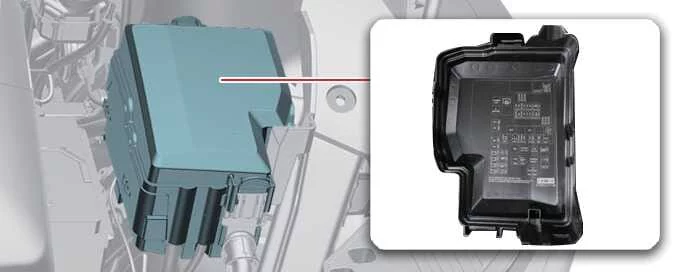
Motor compartment fuse panel
|
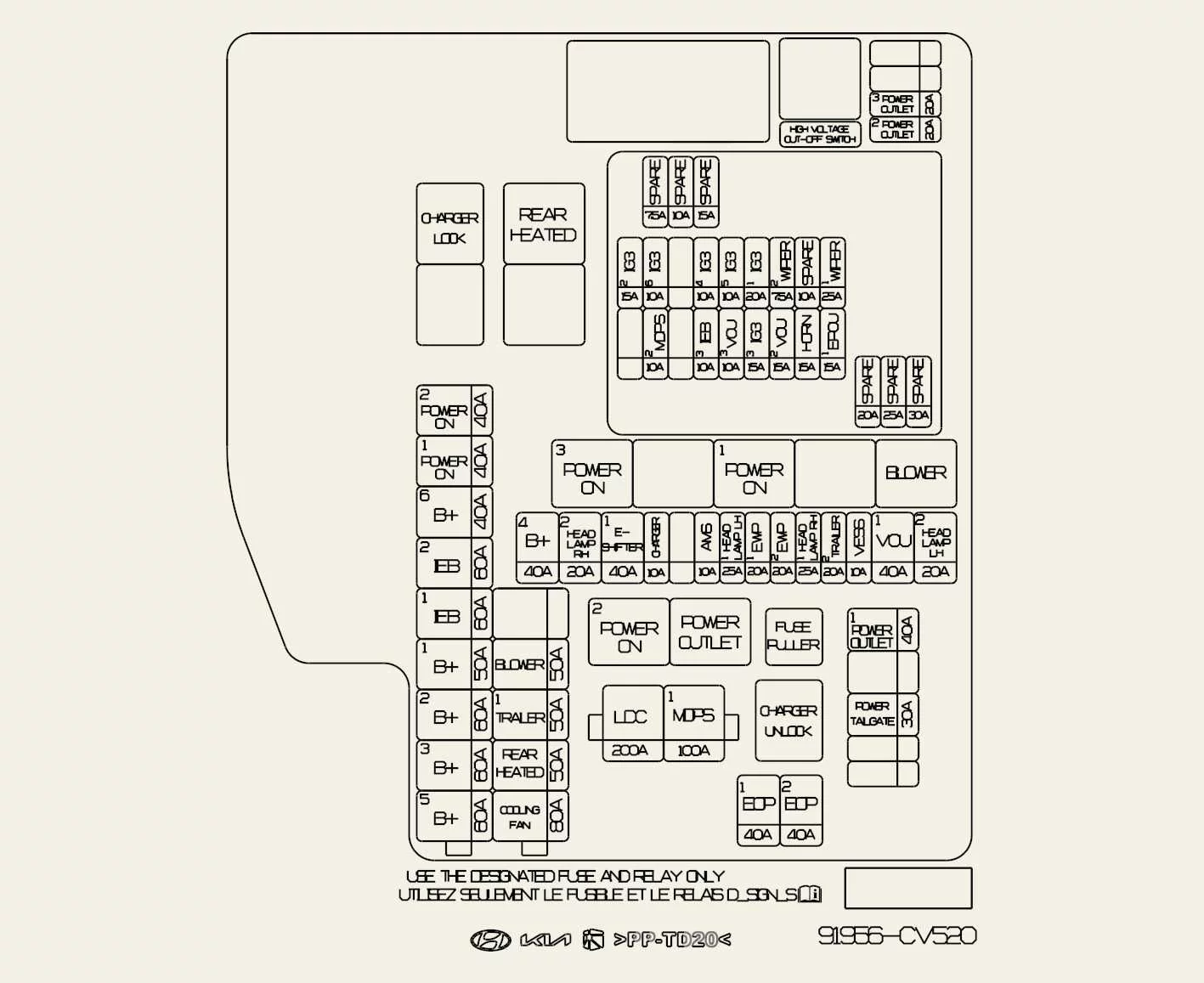
|
зроби сильний реврайт плюс маленьке доповнення англійською мовою мовою, не міняй теги Fuse Name |
Fuse Rating |
Circuit Protected |
|
|---|---|---|---|
|
MULTI FUSE-1 |
|
200A |
P/R Junction Block (Fuse: POWER LITFGATE, EOP1, EOP2, POWER OUTLET1) |
|
|
100A |
EPS Unit |
|
|
MULTI FUSE-3 |
|
40A |
PDC Junction Block (Fuse : MODULE8, AIR BAG2, BMS, E-SHIFTER3, MODULE9, A/C1) |
|
|
60A |
PCB Block (IG3 Main Relay, Fuse: EPCU1, VCU2, WIPER1, HORN) |
|
|
|
60A |
PDC Junction Block (Fuse: EPCU3, P/SEAT DRV, P/SEAT PASS, P/WINDOW LH, P/WINDOW RH, AFCU, SUNROOF1, S/HEATER FRT, S/HEATER RR, AMP, MODULE8, LITFGATE OPEN, CHILD LOCK) |
|
|
|
60A |
PDC Junction Block (IPS1, PS6, IPS8, IPS9, IPS10) |
|
|
|
50A |
PDC Junction Block (IPS2, IPS3, IPS5, IPS7, IPS13) |
|
|
|
60A |
IEB Unit |
|
|
|
60A |
IEB Unit |
|
|
|
40A |
P/R Junction Block (ACC Relay, IG1 Relay) |
|
|
|
40A |
P/R Junction Block (IG2 Relay) |
|
|
MULTI FUSE-2 |
|
80A |
Cooling Fan Motor |
|
|
50A |
P/R Junction Block (Rear Heated Relay) |
|
|
|
50A |
Trailer Connector Unit |
|
|
|
50A |
P/R Junction Block (Blower Relay) |
|
|
FUSE |
|
40A |
PDC Junction Block (Long Term Load Latch Relay, Fuse: BDC1, BRAKE SWITCH, AIR BAG2, A/C2, BATTERY MANAGEMENT, MODULE1, IAU, SPARE3 (B+)) |
|
|
40A |
P/R Junction Block (E-Shifter Relay, Fuse: E-SHIFTER2) |
|
|
|
10A |
P/R Junction Block (Charger Lock/Unlock Relay), ICCU, VCMS |
|
|
|
10A |
CDM |
|
|
|
10A |
12V Battery Sensor |
|
|
|
20A |
Electronic Water Pump #1 |
|
|
|
20A |
Electronic Water Pump #2 |
|
|
|
20A |
Not Used |
|
|
|
10A |
VESS Unit |
|
|
|
40A |
VCU |
|
|
|
40A |
P/R Junction Block (Power Outlet Relay) |
|
|
|
30A |
PTG Unit |
|
|
|
40A |
Rear Electronic Oil Pump |
|
|
|
40A |
Front Electronic Oil Pump (AWD) |
|
|
|
10A |
P/R Junction Block (E-Shifter Relay), SCU, Electronic ATM Shift Dial |
|
|
POWER OUTLET3 |
20A |
Rear Power Outlet |
|
|
POWER OUTLET2 |
20A |
Front Power Outlet |
|

 *1
*1






















*1: MDPS (Motor Driven Power Steering) is the same as EPS (Electric Power Steering).
PCB Block|
Fuse Name |
Fuse Rating |
Circuit Protected |
|---|---|---|
|
|
25A |
PCB Block (Wiper Main Relay) |
|
|
15A |
Front Inverter (AWD) |
|
|
10A |
Spare |
|
|
15A |
PCB Block (Horn Relay) |
|
|
7.5A |
BDC |
|
|
15A |
VCU |
|
|
20A |
PDC Junction Block (Fuse: IG3 7, IG3 8, IG3 9, IG3 10) |
|
|
15A |
Electronic Water Pump |
|
|
10A |
BMS Coolant 3Way Valve |
|
|
10A |
VCU |
|
|
10A |
Front Inverter (AWD), Electronic Water Pump #1, #2, Electronic A/C Compressor |
|
|
10A |
IEB Unit |
|
|
10A |
Cooling Fan Motor, Front Electronic Oil Pump (AWD) |
|
|
10A |
EPS Unit |
|
|
15A |
VCU |







 *1
*1
*1: MDPS (Motor Driven Power Steering) is the same as EPS (Electric Power Steering).
Relay|
Relay No. |
Relay Name |
Type |
|---|---|---|
|
RLY. 1 |
CHARGER LOCK |
MICRO |
|
RLY. 2 |
E-SHIFTER |
MICRO |
|
RLY. 3 |
REAR HEATED |
MINI |
|
RLY. 5 |
ACC |
MICRO |
|
RLY. 7 |
IG1 |
MICRO |
|
RLY. 9 |
BLOWER |
MICRO |
|
RLY. 10 |
IG2 |
MICRO |
|
RLY. 11 |
POWER OUTLET |
MICRO |
|
RLY. 12 |
CHARGER UNLOCK |
MICRO |
Light bulbs ➤
Appearance care ➤
Exterior general caution ➤
Interior general precautions ➤


Other information:
Kia EV6 2022-2026 Owner's Manual: Interior lights
The Kia EV6 is equipped with multiple interior lighting elements designed to improve cabin visibility, convenience, and premium atmosphere throughout the vehicle interior. Avoid using the Kia EV6 interior lights for extended periods while the vehicle is switched OFF. Extended operation of interior lighting may discharge the 12V auxiliary battery.Kia EV6 2022-2026 Owner's Manual: Smart Cruise Control (SCC)
Basic function Kia EV6 Smart Cruise Control detects a vehicle ahead and helps maintain both the selected driving speed and a safe following distance from the vehicle in front. This system is designed to support more comfortable highway driving, long-distance travel, and smoother speed management in traffic. Overtaking Acceleration Assist function When Kia EV6 Smart Cruise Control determines that the driver is attempting to overtake a vehicle ahead, the function may help provide acceleration support.
Contents
- Motor Room Compartment
- Maintenance Services
- Owner Maintenance
- Scheduled Maintenance Service
- Explanation of Scheduled Maintenance Items
- Coolant
- Brake Fluid
- Washer Fluid
- Climate Control Air Filter
- Wiper Blades
- Type A: (if equipped)
- 12V Battery
- Tires and Wheels
- Dedicated Remover Storage Position
- 1. Manufacturer or Brand Identification
- Fuses
- Multi Fuse
- Driver side fuse panel
- Light bulbs
- Appearance care
- Exterior general caution
- Interior general precautions
Categories
- Manuals Home
- Kia EV6 Owners Manual
- Questions & Answers
- Video Guides
- Useful Resources
- New on site
- Most important about Kia EV6
- Privacy Policy
