
Kia Seltos: Driving your vehicle / Brake system
Contents:
- Power brakes
- Parking Brake (Hand type)
- Anti-lock Brake System (ABS)
- Electronic Parking Brake (EPB)
- AUTO HOLD
- ESC system
- Vehicle Stability Management (VSM) system
- Hill-start Assist Control (HAC)
- Downhill Brake Control (DBC)
- Good braking practices
Your Kia Seltos is equipped with power-assisted brakes, a parking brake, and several braking support systems designed to help provide safer and more controlled driving. Proper brake use and regular inspection are important for maintaining reliable stopping performance in everyday traffic, on hills, and in poor weather.
Power brakes
The Kia Seltos has power-assisted brakes that adjust automatically during normal use. This system helps reduce the effort needed to slow or stop the vehicle under regular driving conditions.
If the power-assisted brakes lose assistance because the engine stalls or another problem occurs, you can still stop the vehicle by pressing the brake pedal with greater force. However, the stopping distance will be longer, so slow down carefully and maintain extra space from other vehicles.
When the engine is not running, the reserve brake assist is reduced each time the brake pedal is pressed. Do not repeatedly pump the brake pedal when power assist has been interrupted, because this can use up the remaining brake assistance more quickly.
Pump the brake pedal only when it is necessary to help maintain steering control on slippery surfaces.

NOTICE
-
When pressing the brake pedal in certain driving or weather conditions, you may hear squealing or other brake-related noises. This does not always mean there is a brake malfunction; in many cases, it is a normal operating characteristic.
-
When driving on roads treated with deicing chemicals, the Kia Seltos may produce brake noise or experience unusual tire and brake surface abrasion because of those chemicals. When traffic conditions are safe, apply the brakes lightly to help remove chemical residue from the brake discs and pads.

CAUTION
Brake Pedal
Do not drive with your foot resting on the brake pedal. This can create abnormally high brake temperatures and may cause excessive brake lining and pad wear. It can also reduce braking efficiency and shorten the service life of brake components.

WARNING
Steep hill braking
Avoid holding the brakes continuously when driving down a long or steep hill. Instead, shift to a lower gear so engine braking can help control vehicle speed. Continuous brake application may overheat the brakes and could temporarily reduce braking performance.
Wet brakes can reduce the Kia Seltos braking ability and may cause the vehicle to pull to one side when the brakes are applied. After driving through deep water, lightly apply the brakes while maintaining a safe forward speed to check their condition. Continue applying them gently until normal brake performance returns.
Parking Brake (Hand type)
After parking the Kia Seltos, apply the parking brake to help prevent the vehicle from moving due to slope, wind, vibration, or external force. Always use the parking brake together with the correct transmission position for safer parking.
Anti-lock Brake System (ABS)
The Anti-lock Brake System (ABS) in the Kia Seltos helps prevent the wheels from locking during hard braking, allowing the vehicle to remain more stable and helping the driver maintain steering control.
ABS, and related systems such as ESC, cannot prevent accidents caused by unsafe driving, excessive speed, or sudden improper maneuvers. Although the Kia Seltos can provide improved control during emergency braking, you should always keep a safe distance from vehicles and objects ahead. Vehicle speed should be reduced when road conditions are difficult, especially in the following situations:
-
When driving on rough, gravel, or snow-covered roads.
-
When driving with tire chains installed.
-
When driving on roads with potholes, uneven pavement, or surfaces with different height levels.
Driving in these conditions may increase the stopping distance of your Kia Seltos, even when ABS is operating correctly.
The ABS continuously monitors wheel speed. If the system detects that one or more wheels may lock, it repeatedly adjusts hydraulic brake pressure to help maintain traction and steering control.
When braking on a surface where the wheels could lock, you may hear a "tik-tik" sound from the brakes or feel a pulsing sensation in the brake pedal. This is normal and indicates that the ABS is active.
To get the maximum benefit from ABS during an emergency stop, do not try to manually adjust brake pressure and do not pump the brake pedal. Press the brake pedal firmly and steadily so the ABS can control the braking force automatically.

NOTICE
A clicking sound may be heard inside the passenger compartment when the Kia Seltos begins to move after startup. This is normal and indicates that the ABS is performing its self-check and functioning properly.
Even with ABS, your vehicle still needs sufficient distance to stop safely. Always maintain a safe following distance from the vehicle ahead.
Always slow down before cornering. ABS cannot prevent accidents caused by driving too fast for the road, weather, or traffic conditions.
On loose, rough, or uneven road surfaces, ABS operation may result in a longer stopping distance than a conventional braking system under certain conditions.
The ABS warning light will remain on for approximately 3 seconds after the ENGINE START/STOP button is turned ON.
Type A

Type B

The ABS performs a self-diagnosis, and the warning light turns off if the system is operating normally. If the light stays on, there may be a problem with the ABS. Have your Kia Seltos inspected by an authorized Kia dealer as soon as possible.
When driving on a road with poor traction, such as an icy surface, ABS may operate continuously and the ABS warning light may appear. If this happens, pull the vehicle over to a safe location and stop.
Restart the vehicle. If the ABS warning light turns off, the ABS is operating normally. If the light remains on, there may be a problem with the system. Contact an authorized Kia dealer as soon as possible for inspection.

NOTICE
When jump starting the Kia Seltos because of a discharged battery, the vehicle may not run smoothly at first and the ABS warning light may turn on at the same time. This can happen because of low battery voltage and does not necessarily mean the ABS has malfunctioned.
-
Do not pump the brakes.
-
Have the battery fully recharged before driving the vehicle normally.
Electronic Parking Brake (EPB)
AUTO HOLD
Auto Hold in the Kia Seltos is designed to keep the vehicle stationary after the driver brings it to a complete stop, even when the brake pedal is released. This function can add comfort in traffic, at intersections, or during repeated stop-and-go driving.
ESC system ➤
Vehicle Stability Management (VSM) system ➤
Hill-start Assist Control (HAC)
A vehicle may tend to roll backward when starting from a stop on a steep hill. Hill-start Assist Control (HAC) in the Kia Seltos helps prevent rollback by automatically applying the brakes for approximately 2 seconds after the brake pedal is released.
The brakes are released when the accelerator pedal is pressed or after about 2 seconds, whichever occurs first.
HAC operates only for a short time, so when starting on an incline, always press the accelerator smoothly and be prepared to control the vehicle. This feature is designed to assist the driver, not to hold the vehicle indefinitely.

WARNING
Maintaining Brake Pressure on Incline
HAC does not replace the need to use the brakes while stopped on an incline. When stopped, make sure you maintain enough brake pressure to prevent the Kia Seltos from rolling backward and causing an accident. Do not release the brake pedal until you are ready to accelerate forward.
Downhill Brake Control (DBC)
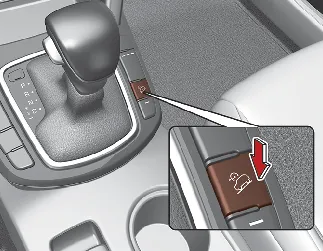
Downhill Brake Control (DBC) helps the driver descend a steep hill without constantly pressing the brake pedal.
The system automatically applies the brakes to help maintain vehicle speed between 2.5 mph (4 km/h) and 25 mph (40 km/h), allowing the driver to focus more on steering the Kia Seltos safely downhill.
Always turn off DBC when driving on normal roads. If left in standby mode, DBC may activate unexpectedly when driving over speed bumps, through sharp curves, or on certain uneven road surfaces.

NOTICE
DBC returns to the OFF position whenever the ignition switch is placed in the ON position.
Noise or vibration from the brakes may occur when DBC is activated. This is normal and does not necessarily indicate a malfunction.
The rear stop light turns on when DBC is activated, helping alert drivers behind the Kia Seltos that the vehicle is braking during a downhill descent.
Good braking practices
Good braking practices help keep Kia Seltos occupants safe, support stable vehicle control, and extend the service life of brake components.
-
Before driving away, check that the parking brake is fully released and that the parking brake indicator light is off.
-
Driving through water can make the brakes wet. Brakes can also become wet after the vehicle is washed. Wet brakes can be dangerous because the Kia Seltos may not stop as quickly, and the vehicle may pull to one side when the brakes are applied.
To dry the brakes, apply them lightly while driving at a safe speed until normal braking action returns. Keep the vehicle under control at all times. If braking performance does not return to normal, stop as soon as it is safe and contact an authorized Kia dealer for assistance.
-
Do not coast down hills with the vehicle out of gear. This is extremely dangerous. Always keep the Kia Seltos in gear, use the brakes to slow the vehicle, and shift to a lower gear when needed so engine braking can help maintain a safe speed.
-
Do not "ride" the brake pedal. Resting your foot on the brake pedal while driving can overheat the brakes, reduce braking effectiveness, and increase wear on brake pads, linings, and related components.
-
If a tire goes flat while driving, apply the brakes gently and keep the vehicle pointed straight ahead as you slow down. When the Kia Seltos is moving slowly enough to stop safely, pull off the road and stop in a secure location.
-
Use caution when parking on a hill. Firmly apply the parking brake and place the shifter in P (Park). If the vehicle is facing downhill, turn the front wheels toward the curb to help prevent rolling.
If the vehicle is facing uphill, turn the front wheels away from the curb. If there is no curb, or if road conditions require extra protection, block the wheels to help keep the vehicle from moving.
-
Under certain conditions, the parking brake may freeze in the engaged position. This is most likely when snow or ice builds up around the rear brakes, or when the brakes are wet in freezing temperatures. If there is a risk that the parking brake may freeze, apply it only temporarily while placing the shifter in P (Park) and blocking the rear wheels. Then release the parking brake.
-
Do not hold the Kia Seltos on an incline by pressing the accelerator pedal. This can overheat the transmission. Always use the brake pedal or parking brake to hold the vehicle in place.


Other information:
Kia Seltos SP2 (2021-2026) Owner's Manual: Driver Attention Warning (DAW)
Inattentive Driving Warning function Driver Attention Warning (DAW) in the Kia Seltos monitors driving patterns while the vehicle is being driven. If the system determines that the driver's attention level has dropped below a certain point, DAW may recommend taking a break to help support safer driving. Leading Vehicle Departure Alert function Leading Vehicle Departure Alert informs the driver when the detected vehicle in front begins moving away from a stop.Kia Seltos SP2 (2021-2026) Owner's Manual: User Settings mode
In the Kia Seltos User Settings mode, you can customize several vehicle functions directly through the instrument cluster. This menu allows the driver to adjust cluster preferences, lighting behavior, door functions, convenience features, units, language, and reset options. Driver Assistance Cluster Lights Door Convenience Units Language Reset The available information and settings may differ depending on the systems and equipment installed in your Kia Seltos.