
Kia Seltos: Child Restraint System (CRS) / Selecting a CRS
Contents:
When selecting a Child Restraint System for your child, always choose a restraint that fits the child, fits the Kia Seltos seating position, and can be installed according to the manufacturer's instructions.
-
Make sure the CRS has a label certifying that it meets FMVSS 213.
-
Select a child restraint based on your child's height and weight. The required label or the user instructions usually provide this information.
-
Select a child restraint that fits the vehicle seating position where it will be used.
-
Read and follow all warnings, installation steps, and use instructions provided with the CRS.

WARNING
Holding children
Never hold a child in your arms or on your lap while riding in the Kia Seltos. The violent forces created during a crash can pull the child from your arms and throw the child against the vehicle interior. Always use a Child Restraint System that is appropriate for the child's height and weight.

WARNING
Unattended children
Never leave children unattended inside the Kia Seltos. The cabin can heat up very quickly, especially in sunny weather, and may cause serious injury or death. Children may also operate vehicle controls unexpectedly if left alone.

WARNING
Seat belt use
Do not use one seat belt for two occupants at the same time. A single belt cannot properly restrain two people and will remove much of the safety benefit that the seat belt is designed to provide.
Before each trip in the Kia Seltos, confirm that every child is secured in the correct restraint or seat belt for their age, height, and weight.
CRS types
There are three main types of Child Restraint Systems (CRS): rear-facing seats, forward-facing seats, and booster seats. Each type is selected according to the child's age, height, weight, and the limits specified by the child restraint manufacturer.
Choosing the correct CRS for the Kia Seltos is important because each stage is designed to support the child's body differently during normal driving, sudden stops, and collisions.
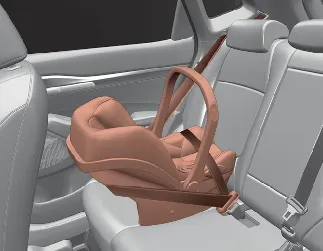
Rear-facing child seats
A rear-facing child seat supports the child with the seating surface against the back of the child's body. The harness system holds the child securely in place, and during an accident it helps keep the child properly positioned while reducing stress on the neck and spinal cord.
All children under age one must always ride in a rear-facing infant child restraint.
Convertible and 3-in-1 child seats usually provide higher height and weight limits for the rear-facing position, allowing a child to remain rear-facing for a longer period.
Continue using a rear-facing child seat in the Kia Seltos for as long as the child fits within the height and weight limits allowed by the child seat manufacturer. This is one of the safest ways to transport young children. Once the child has outgrown the rear-facing restraint, the child is ready for a forward-facing child restraint with a harness.
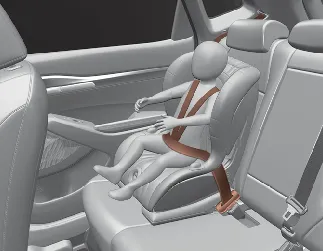
Forward-facing child restraints
A forward-facing child seat restrains the child's body with a built-in harness. Children should remain in a forward-facing child restraint with a harness until they reach the maximum height or weight limit allowed by the child restraint manufacturer.
When the child outgrows the forward-facing child restraint, the next step is a booster seat that helps position the Kia Seltos seat belt correctly.
Booster seats
A booster seat is designed to improve the fit of the vehicle's seat belt system. It raises the child so the lap and shoulder belt can sit in the proper position across the body.
Keep your child in a booster seat until the child is large enough to sit on the vehicle seat without a booster and still have the seat belt fit correctly. For proper fit, the lap belt must lie snugly across the upper thighs, not across the stomach. The shoulder belt should lie snugly across the shoulder and chest, not across the neck or face.
Children age 13 and under should always ride in the rear seats of the Kia Seltos and must always be properly restrained to reduce the risk of injury.


Other information:
Kia Seltos SP2 (2021-2026) Owner's Manual: Emergency towing
If a professional towing service is not available during an emergency, your Kia Seltos may be temporarily towed using a suitable cable, chain, or towing strap attached only to the emergency towing hook located under the front or rear of the vehicle. Front Rear If towing is necessary, it is always best to have the Kia Seltos handled by an authorized Kia dealer or a professional commercial tow-truck service.Kia Seltos SP2 (2021-2026) Owner's Manual: Conditions and operation of the front passenger ODS
Condition detected by the occupant detection system Indicator/Warning light Devices "PASSENGER AIR BAG OFF" indicator light SRS warning light Front passenger air bag 1.