
Kia K4: What to do in an emergency / Tire Pressure Monitoring System (TPMS)
Contents:
- Effective use of TPMS
- Low tire pressure indicator light
- TPMS malfunction indicator
- Tire replacement with TPMS
The Kia K4 is equipped with a sophisticated Tire Pressure Monitoring System (TPMS) that continuously monitors the inflation pressure of each tire and transmits this data to the instrument cluster for your convenience.
|
|
-
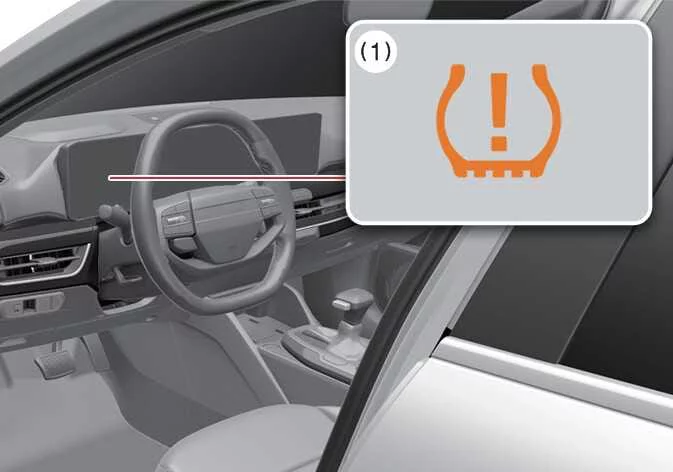
Low tire pressure or TPMS malfunction indicator light.
-
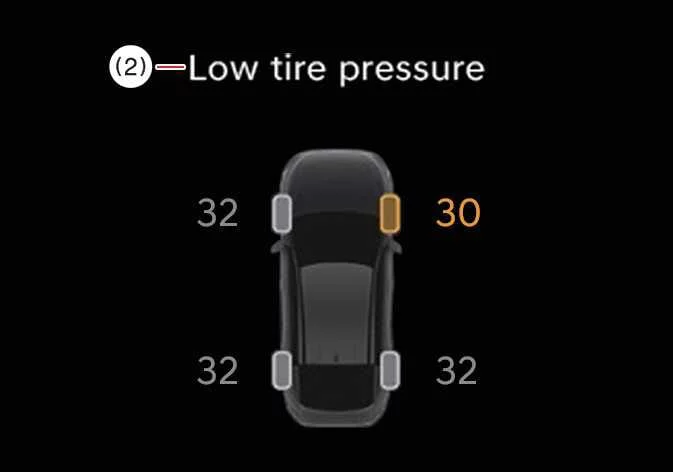
Low tire pressure position indicator light (graphical representation on the instrument cluster).
Tire pressure indicator
-
You can conveniently view current tire pressure levels by accessing the "Assist" mode in the instrument cluster menu. For detailed instructions on how to navigate this, please refer to the "LCD Display Modes" section of the manual.
-
The tire pressure readings will typically appear on your Kia K4 display approximately 1–2 minutes after you begin driving.
-
If the tire pressure does not appear while stationary, a "Drive to display" warning message will appear. Continue driving for a short distance to allow the system to update, then check the pressures again.
-
You may customize your preferred tire pressure units—choosing between psi, kPa, or bar—within the User Settings menu on the instrument cluster.
TIP
-
Please note that tire pressure is subject to change based on ambient temperature, parking conditions, driving style, and your current altitude.
-
The digital reading displayed on the Kia K4 instrument cluster may vary slightly from readings taken with a manual handheld tire pressure gauge due to sensor calibration and operating temperatures.
-
The system may trigger a low-pressure warning if one tire's pressure is lower than the others; this is a normal operational response as the system calculates pressure differences relative to tire temperature and environmental changes.
Effective use of TPMS
To ensure optimal safety and performance, every tire on your Kia K4—including the spare if provided—should be inspected monthly when the tires are "cold." Please inflate them precisely to the pressure levels recommended by the manufacturer, which can be found on the vehicle placard located on the driver's side door jamb or the tire inflation pressure label.
If you have installed tires of a different size than those originally specified for the Kia K4, it is your responsibility to determine and maintain the correct inflation pressure suitable for those specific aftermarket tires.
As a sophisticated safety enhancement, your Kia K4 is equipped with a Tire Pressure Monitoring System (TPMS). This system illuminates a dedicated low-tire-pressure warning light on the instrument cluster whenever one or more of your tires are significantly under-inflated. Should this warning light appear, you should safely stop your vehicle as soon as possible, inspect all tires, and inflate them to the manufacturer-recommended pressure. Please be aware that driving on an under-inflated tire can cause it to overheat, which significantly increases the risk of sudden tire failure. Furthermore, consistent under-inflation negatively impacts fuel efficiency, shortens tire tread life, and compromises the handling and braking performance of your Kia K4.
It is crucial to understand that the TPMS is intended as a supplemental safety feature and is not a substitute for regular, manual tire maintenance. It remains the driver's responsibility to periodically verify that all tires are at the correct pressure, even if the TPMS warning light has not been triggered.
Your Kia K4 also features a TPMS malfunction indicator designed to alert you if the system is not operating correctly. This indicator is integrated with the low-tire-pressure warning light. If the system detects a technical fault, the light will flash for approximately one minute and then remain continuously illuminated. This sequence will repeat each time you start the engine until the underlying fault is resolved. While this malfunction indicator is active, the system may be unable to monitor or detect low pressure in your Kia K4 tires effectively. Malfunctions can stem from various causes, including the installation of replacement tires or wheels that are incompatible with the vehicle's sensors.
Always verify the status of the TPMS indicator after replacing one or more tires or wheels on your Kia K4 to ensure that the new equipment allows the monitoring system to function as designed.
WARNING
Both over-inflation and under-inflation can severely reduce the lifespan of your tires and negatively affect the handling characteristics of your Kia K4. Incorrect pressure can lead to sudden tire failure, which may cause you to lose control of the vehicle and result in a serious accident.
NOTE
Please have your Kia K4 inspected by an authorized Kia dealer if you encounter any of the following circumstances:
-
The low tire pressure or TPMS malfunction indicator light fails to illuminate for approximately 3 seconds when the ignition is in the ON position or when the engine is running.
-
The TPMS malfunction indicator light remains continuously illuminated after flashing for approximately 1 minute.
-
The specific low tire pressure position indicator light fails to extinguish or remains illuminated despite proper inflation.
Low tire pressure indicator light
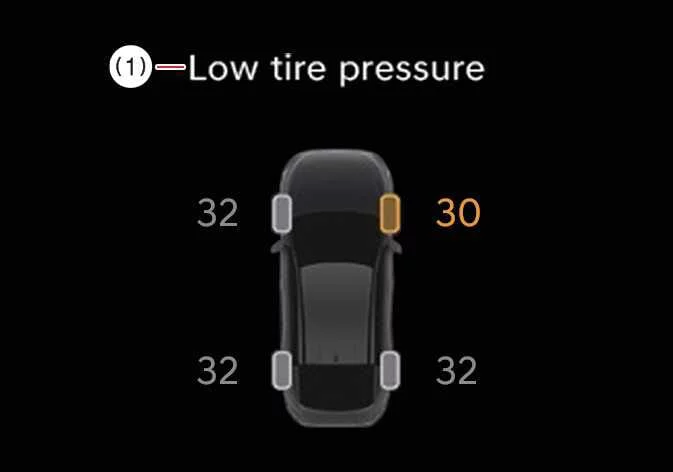
When the TPMS warning indicators illuminate on the instrument cluster of your Kia K4, it serves as a critical notification that one or more of your tires are significantly under-inflated. This system is designed to help maintain vehicle safety and optimal tire performance.
|
|
Should this indicator light activate while driving your Kia K4, you must immediately reduce your speed. Avoid sudden or sharp steering maneuvers and be prepared for potentially increased braking distances. Find a safe location to pull over and inspect your tires as soon as possible.
Once stopped, inflate your tires to the precise pressure specifications listed on the vehicle's placard or the tire inflation pressure label, which is conveniently located on the driver-side center pillar outer panel. If you are unable to reach a service station or if a tire is punctured and cannot hold air, you should safely replace the affected tire with the spare wheel provided with your Kia K4.
Please note that if the TPMS malfunction and low tire pressure indicator lights illuminate after restarting the Kia K4, you have approximately 20 minutes of continuous driving time before you are strongly advised to have the low-pressure tire repaired or replaced at a professional facility.
During colder months or significant temperature drops, you may notice that the low tire pressure indicator light illuminates even if you previously adjusted your tire pressure during warmer weather. This is not indicative of a TPMS malfunction; rather, it is a physical reality where decreased ambient temperatures lead to a natural, proportional drop in internal tire pressure.
To maintain peak performance, periodically check and adjust your Kia K4 tire pressure under the following environmental conditions:
-
When traveling from a warm geographic region to a significantly colder area.
-
When transitioning from a cold climate to a warmer driving environment.
-
Whenever you are operating your Kia K4 in conditions where the outside temperature is extremely high or extremely low.
Be aware that simply adding air might not immediately extinguish the warning light if the tire inflator used at a service station has a margin of error. In most cases, the low tire pressure indicator light for the Kia K4 will automatically turn off once the system detects that the tire pressure has been restored to or slightly above the manufacturer's recommended level.
WARNING
Low pressure damage
Do not attempt to drive your Kia K4 on significantly under-inflated tires. Extremely low pressure causes excessive tire deformation, which leads to rapid overheating and potential structural failure. This creates a highly unstable vehicle, increases your braking distance, and significantly raises the risk of losing control, which could lead to a serious accident.
TPMS malfunction indicator
If the Tire Pressure Monitoring System (TPMS) in your Kia K4 encounters a technical fault or internal error, the low tire pressure indicator light ( ) will blink for approximately one minute and then remain continuously illuminated. This specific flashing pattern serves as a clear diagnostic alert that the monitoring system requires professional attention.
In certain scenarios, your Kia K4 may identify both a system malfunction and a genuine low-pressure condition simultaneously. In such cases, the instrument cluster will display both the TPMS malfunction light and the specific low tire pressure position indicator lights. For instance, if the front left wheel sensor fails, the master TPMS malfunction light will trigger. If, at the same time, the front right, rear left, or rear right tires are detected as under-inflated, their respective position indicator lights will appear alongside the master malfunction alert, providing a comprehensive status of your vehicle's tire health.
To ensure your continued safety, have your Kia K4 inspected by an authorized Kia dealer as soon as possible to pinpoint and resolve the underlying issue. Be aware that the TPMS malfunction indicator may temporarily illuminate due to external environmental factors rather than internal hardware failure:
-
Driving the Kia K4 in the vicinity of high-intensity electromagnetic fields—such as those near police stations, government offices, broadcasting towers, military installations, airports, or major electrical power supply cables—may cause signal interference that disrupts the normal operation of your TPMS.
-
The usage of aftermarket accessories or electronic equipment inside the cabin can also create interference. The TPMS malfunction light may trigger if the Kia K4 is equipped with metal tire chains or if you are actively using high-powered personal electronics, such as a laptop computer, an aftermarket remote starter, a mobile device charger, or an external GPS navigation system, which may emit signals that interfere with the sensors.
Note on System Reset: In many instances where external interference is the cause, the TPMS indicator will reset itself automatically once you move the Kia K4 away from the source of the interference. If the warning light remains illuminated after you have moved to an area free of electromagnetic obstacles, please visit your local dealership for a complete system diagnostic.
Tire replacement with TPMS
If you experience a flat tire while operating your Kia K4, the low tire pressure indicator light will illuminate on your instrument cluster. You should have your vehicle inspected by an authorized Kia dealer as soon as possible, or perform an emergency change by replacing the compromised tire with the vehicle's spare tire.
It is important to note that every wheel on your Kia K4 is equipped with an integrated tire pressure sensor mounted securely inside the tire, directly behind the valve stem. Because of this specialized technology, you must always use TPMS-specific wheels. To ensure the longevity of these components, we strongly recommend that all tire service and mounting procedures be performed by a certified technician at an authorized Kia dealer.
Please be aware that if you replace a low-pressure tire with the spare, the low tire pressure indicator light will remain illuminated until the original, damaged tire is properly repaired or replaced and reinstalled on the Kia K4.
Furthermore, you may notice that the TPMS malfunction indicator light appears a few minutes after you install the spare tire. This occurs because the spare wheel does not contain an active, synchronized TPMS sensor. This is a normal system response and does not indicate a mechanical failure of your Kia K4.
Once you have inflated your original tire to the manufacturer's recommended pressure and reinstalled it on the vehicle—or if you have mounted an active TPMS sensor on a replacement wheel and had it programmed by an authorized Kia dealer—the TPMS malfunction and low tire pressure indicator lights will automatically turn OFF within a few minutes of driving as the system re-establishes a connection with the sensors.
If the warning lights do not extinguish after several minutes of driving at normal speeds, please visit an authorized Kia dealer to have the system recalibrated.
If you choose to use the spare tire, the system must recognize that the TPMS sensor on the spare is not active, and the sensor on the original wheel—now in the spare tire carrier—should be inactive. If the TPMS sensor on the original wheel remains active while stored in the trunk, it may cause signal interference, preventing the TPMS from operating properly on your Kia K4. If this occurs, have the original tire serviced or properly stored by an authorized Kia dealer.
Finally, remember that you cannot reliably identify a low-pressure tire simply by visual inspection. Always use a high-quality, calibrated tire pressure gauge to measure inflation. Keep in mind that a tire that has been driven will show a higher pressure reading due to heat; for the most accurate results, measure your Kia K4 tire pressure when "cold"—defined as having been stationary for at least 3 hours or driven for less than 1 mile (1.6 km) during that 3-hour window.
Always allow the tires on your Kia K4 to cool thoroughly before measuring the inflation pressure. Accurate readings are only possible when the tires are "cold," meaning the vehicle has been stationary for at least three hours or driven for less than one mile (1.6 km). Always ensure the tires are in this cold state before inflating them to the pressure recommended by the manufacturer.
Important: Do not use tire sealants. If your Kia K4 is equipped with the factory Tire Pressure Monitoring System (TPMS), you must strictly avoid using generic liquid tire sealants. These chemical substances can coat, clog, and permanently damage the delicate tire pressure sensors mounted inside the wheels, leading to the following critical issues:
-
The TPMS will be unable to accurately monitor your tire health or alert you to severe, sudden pressure loss caused by external factors such as road debris, sharp objects, or structural tire damage.
-
If you experience any sensation of vehicle instability or pull, immediately remove your foot from the accelerator, apply the brakes gently and gradually, and steer your Kia K4 to a safe location off the roadway.
CAUTION
Repair Agents
Never utilize a puncture-repairing agent or sealant that is not specifically approved by Kia. Non-approved sealants can chemically degrade or physically obstruct the TPMS sensor, rendering it ineffective and requiring costly replacement of the sensor components on your Kia K4.
NOTE
Protecting the TPMS
Any tampering, unauthorized modifications, or intentional disabling of the TPMS hardware will interfere with the system's ability to provide critical warnings regarding low tire pressure or system malfunctions. Furthermore, such actions may void the vehicle's warranty regarding the affected electronic components.
This device complies with Part 15 of the FCC rules.
Operation of the Kia K4 TPMS is subject to the following two conditions:
-
This device must not cause harmful electromagnetic interference.
-
This device must accept any interference received, including interference that might cause undesired operation of the monitoring system.
TIP
Any changes or modifications to the TPMS hardware that are not expressly approved by the party responsible for regulatory compliance could void the user’s authority to operate this equipment, potentially affecting the safety features of your Kia K4.


Other information:
Kia K4 (CL4) 2025-2026 Owner's Manual: Installing a child restraint system (CRS)
After selecting the appropriate child safety seat for your little one, it is vital to verify that it fits securely and correctly within the interior of your Kia K4. Proper fitment is the cornerstone of effective passenger protection. Always adhere strictly to the installation instructions provided by the child seat manufacturer. When preparing to install the seat in your Kia K4, please follow these essential steps: Secure the child restraint to the vehicle: Every child restraint must be firmly anchored to the vehicle using either the lap portion of a 3-point lap/shoulder seat belt or the integrated LATCH (Lower Anchors and Tethers for Children) system.Vehicles equipped with the advanced Kia K4 proximity smart key system offer enhanced security and daily convenience. With this high-tech proximity fob in your pocket, purse, or jacket, you can seamlessly lock or unlock the passenger doors, release the trunk lid, and even start the engine without ever inserting a physical key blade into the steering column ignition switch.