Kia K4: Blind-Spot Collision-Avoidance Assist (BCA): / Limitations of Blind-Spot Collision-Avoidance Assist
Contents:
The Blind-Spot Collision-Avoidance Assist (BCA) system integrated into your Kia K4 is a sophisticated driver-assistance feature; however, it is subject to certain operational constraints. You may experience abnormal, unexpected, or limited performance under the following environmental and driving conditions:
-
Adverse Weather: Heavy snowfall, torrential rain, or thick fog can obscure sensor visibility.
-
Sensor Obstruction: The radar detection sensors are covered by mud, road grime, heavy snow, or other foreign materials.
-
Extreme Temperatures: The ambient temperature surrounding the radar sensors is excessively high or low.
-
Proximity Interference: Sensors are obstructed by nearby structures such as pillars, walls, or other passing vehicles.
-
Complex Road Infrastructure: Driving on highway ramps, through tollgate facilities, or areas with dense metallic debris from construction.
-
Fixed Object Interference: Driving near sound barriers, guardrails, tunnel walls, overhead signs, or street lights that may cause radar reflection issues.
-
Roadside Vegetation: Driving on narrow roads where overgrown foliage contacts the vehicle.
-
Open Environments: Driving in wide-open, featureless areas where the Kia K4 sensors lack sufficient reference objects.
-
Wet Road Surfaces: Driving on surfaces that cause significant water spray or reflection.
-
Traffic Dynamics: Situations where vehicles are passing at extremely high speeds, moving very close to your rear, or when you are actively changing lanes.
-
Simultaneous Acceleration: When you and the vehicle in the adjacent lane accelerate at the same time.
-
Complex Lane Maneuvers: When a vehicle in the next lane moves two lanes away, or a vehicle from two lanes away moves into the immediate adjacent lane.
-
Aftermarket Attachments: Installation of trailers, bike carriers, or bumper stickers near the rear corner radar locations.
-
Physical Damage/Misalignment: The front or rear bumper area is damaged, or the radar sensor module is physically out of its correct alignment.
-
Vehicle Load/Geometry: Significant changes to vehicle height caused by heavy cargo, unevenly distributed weight, or incorrect tire pressure.
-
Specific Object Detection: The system may have difficulty identifying specialized objects such as:
- Motorcycles or bicycles.
- Vehicles towing flat-bed trailers.
- Large commercial vehicles like buses or semi-trucks.
- Moving non-vehicular obstacles, including pedestrians, animals, shopping carts, or strollers.
- Extremely low-profile vehicles, such as certain sports cars.
Furthermore, be aware that automatic braking control may be inhibited or limited under these conditions:
- Severe vehicle vibration (e.g., driving over deep potholes or extremely bumpy terrain).
- Driving on slippery surfaces such as ice, packed snow, or standing water.
- Low or improperly maintained tire pressure, or damaged tires.
- Unauthorized modifications to the original braking system of the Kia K4.
- Sudden, abrupt steering inputs by the driver.
WARNING
-
Driving on curved roads: The Kia K4 Blind-Spot Collision-Avoidance Assist may struggle to detect vehicles in the next lane during tight curves. Always maintain full situational awareness.
-
Driving on inclined roads (slopes): The system may incorrectly interpret the road surface or structure rather than an adjacent vehicle on steep inclines.
-
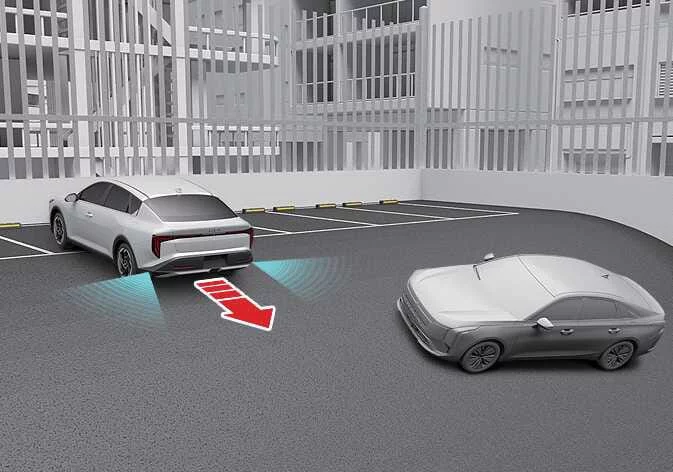
Merging or dividing roads: The Blind-Spot Collision-Avoidance Assist may fail to identify vehicles correctly at merging points.
-
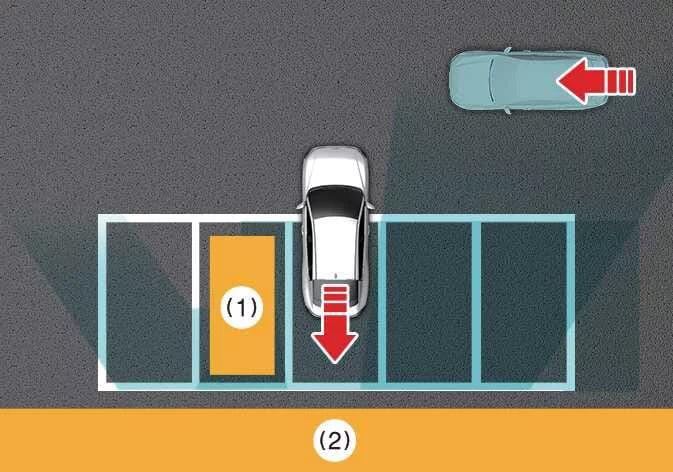
Roads with height differences: Detection can be compromised at grade-separated intersections or underpass junctions where lane heights differ significantly.
WARNING
- Always turn OFF the Blind-Spot Collision-Avoidance Assist system in your Kia K4 when towing a trailer or other vehicles to avoid false alerts.
- The system may experience performance degradation in areas with heavy electromagnetic interference.
- Note that the system may require up to 3 seconds to fully initialize after starting your Kia K4 before it can reliably detect surrounding traffic.
This device complies with Part 15 of the FCC rules.
Operation of the Kia K4 is subject to the following two conditions:
-
This device may not cause harmful interference, and
-
this device must accept any interference received, including interference that may cause undesired operation of the Kia K4 systems.
TIP
Any changes or modifications to the Kia K4 electronic systems not expressly approved by the party responsible for compliance could void the user's authority to operate this equipment.


Other information:
Kia K4 (CL4) 2025-2026 Owner's Manual: Fuse/relay panel description
Located on the interior side of the fuse and relay panel covers, you will find a detailed label identifying the function, name, and amperage capacity of each fuse and relay for your Kia K4. This information is essential for troubleshooting electrical systems efficiently. TIP While the fuse panel descriptions provided in this manual are accurate as of the printing date, please be aware that minor variations in configuration may occur depending on the specific trim level, production date, and optional equipment fitted to your Kia K4.Condition detected by the occupant detection system Indicator/Warning light Devices Devices PASSENGER AIR BAG OFF SRS warning light Front passenger air bag 1.