
Kia EV6: Driving your vehicle / Vehicle load limit
Contents:
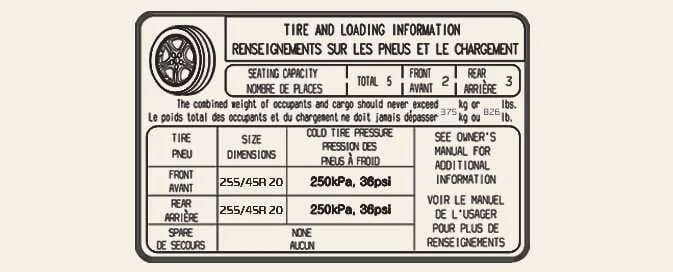
The Kia EV6 vehicle load limit information is displayed on the tire and loading information label located on the driver’s door area.
Tire and loading information label
The label located on the driver-side door sill identifies the original Kia EV6 tire size, recommended cold tire inflation pressures, seating capacity, and maximum vehicle capacity weight.
|
Standard type: 826 lbs. (375 kg)
Extended type: 826 lbs. (375 kg)
The Kia EV6 vehicle capacity weight represents the maximum combined weight of passengers and cargo that the vehicle can safely carry.
If a trailer is attached, the trailer tongue load must also be included in the total vehicle load calculation.
Seating capacity:Total: 5 persons (Front seat: 2 persons, Rear seat: 3 persons)
The seating capacity indicates the maximum number of occupants that may ride inside the Kia EV6.
The available passenger capacity may be reduced depending on passenger weight, cargo weight, or trailer tongue load being carried by the vehicle.
Never overload the Kia EV6 beyond the specified load limit, as excessive weight may negatively affect handling, braking, tire performance, suspension durability, and overall vehicle safety.
Towing capacity:-
Standard type: N/A
-
Extended type
-
With brake system: 2,700 lbs. (1,224 kg)
-
Without brake system: 1,653 lbs. (750 kg)
-
The Kia EV6 towing capacity represents the maximum allowable trailer weight, including all cargo loaded inside the trailer.
Cargo capacity:The cargo carrying capacity of the Kia EV6 may increase or decrease depending on the number of occupants, trailer tongue load, and total cargo weight carried inside the vehicle.
Steps for Determining Correct Load Limit —
(1) Locate the statement on the Kia EV6 tire and loading information placard that says: "The combined weight of occupants and cargo should never exceed XXX kg or XXX lbs.'' This value represents the maximum combined load that your specific vehicle can safely carry.
(2) Calculate the total combined weight of the driver and all passengers who will be riding in the Kia EV6.
(3) Subtract the combined weight of the driver and passengers from the maximum load value shown as XXX kg or XXX lbs. on the vehicle placard.
(4) The remaining number is the available cargo and luggage load capacity for the Kia EV6. For example, if the “XXX� value equals 1400 lbs. and five passengers weighing 150 lbs. each will ride in the vehicle, the remaining cargo and luggage capacity is 650 lbs. (1400-750 (5 x 150) = 650 lbs.)
(5) Determine the total weight of all luggage, cargo, tools, accessories, and other items being loaded into the vehicle. This total must not exceed the available cargo and luggage capacity calculated in Step 4.
(6) If the Kia EV6 will be towing a trailer, part of the trailer load will be transferred to the vehicle through the trailer tongue. Refer to this manual to determine how trailer tongue load reduces the available cargo and luggage capacity of the Kia EV6.
WARNING
Loose Cargo
Do not travel with unsecured objects inside the passenger compartment of the Kia EV6, such as suitcases, tools, packages, or unsecured child seats. During sudden braking, sharp turns, or a collision, loose items may move violently and strike occupants, causing serious injury.
|
|
Item |
Description |
Total |
|---|---|---|
|
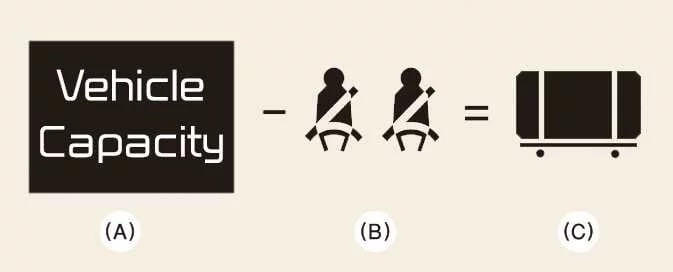
(A) |
Vehicle Capacity Weight |
849 lb (385 kg) |
|
(B) |
Subtract Occupant Weight 150 lbs. (68 kg) × 2 |
300 lb (136 kg) |
|
(C) |
Available Cargo and Luggage Weight |
549 lb (249 kg) |
|
|
Item |
Description |
Total |
|---|---|---|
|
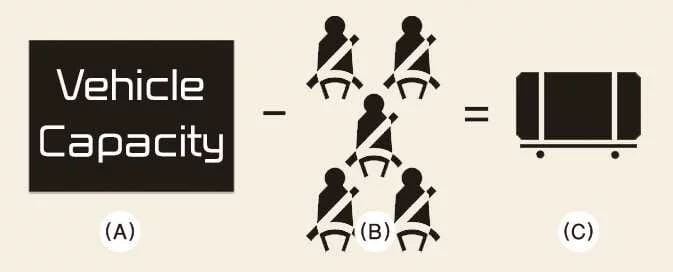
(A) |
Vehicle Capacity Weight |
849 lb (385 kg) |
|
(B) |
Subtract Occupant Weight 150 lbs. (68 kg) × 5 |
750 lb (340 kg) |
|
(C) |
Available Cargo and Luggage Weight |
99 lb (45 kg) |
|
|
Item |
Description |
Total |
|---|---|---|
|
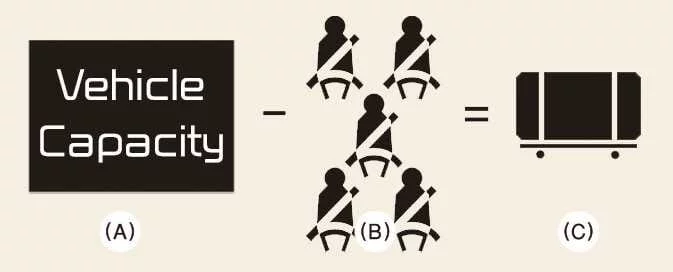
(A) |
Vehicle Capacity Weight |
849 lb (385 kg) |
|
(B) |
Subtract Occupant Weight 161 lbs. (73 kg) × 5 |
805 lb (365 kg) |
|
(C) |
Available Cargo and Luggage Weight |
44 lb (20 kg) |
Refer to the Kia EV6 tire and loading information label for the exact vehicle capacity weight and seating position information for your specific model. The combined weight of the driver, passengers, cargo, luggage, accessories, and any trailer tongue load must never exceed the vehicle capacity weight.
Certification label
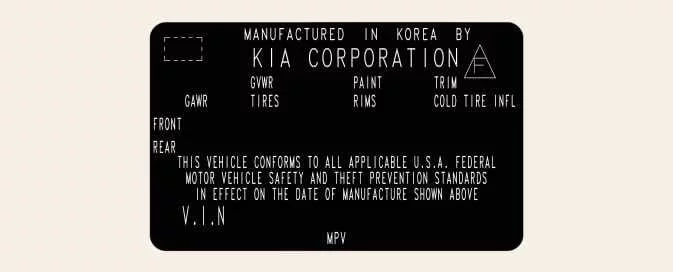
The certification label is located on the driver-side door sill at the center pillar of the Kia EV6.
|
This label shows the maximum allowable weight of the fully loaded Kia EV6. This rating is known as the GVWR, or Gross Vehicle Weight Rating. The GVWR includes the vehicle itself, all occupants, cargo, luggage, and installed equipment.
The certification label also identifies the maximum weight that can be supported by the front and rear axles. This value is called the GAWR, or Gross Axle Weight Rating.
To determine the actual load placed on the front and rear axles, take the Kia EV6 to a certified weigh station and weigh the vehicle. An authorized Kia dealer can help explain this process and assist with proper loading recommendations.
Always distribute cargo evenly from side to side and avoid placing excessive weight on one side of the vehicle.
WARNING
Over Loading
Never exceed the GVWR, the GAWR for either axle, or the stated vehicle capacity weight of the Kia EV6. Exceeding these ratings can reduce braking performance, affect handling stability, overload tires and suspension components, and increase the risk of an accident.
The certification label helps determine how much cargo, luggage, accessories, and installed equipment the Kia EV6 can safely carry.
Loose items inside the vehicle, such as suitcases, tools, packages, sports equipment, or personal belongings, travel at the same speed as the vehicle. During sudden braking, sharp turning, or a crash, these objects may continue moving and strike the driver or passengers.
WARNING
Over Loading
Do not overload the Kia EV6. Excessive vehicle loading can cause tire heat buildup, possible tire failure, increased stopping distance, poor steering response, reduced stability, and a higher risk of collision.
NOTE
Overloading the Kia EV6 may cause mechanical damage, tire damage, or suspension wear. Repairs caused by overloading may not be covered by the vehicle warranty. Always remain within the approved load limits.


Other information:
Kia EV6 2022-2026 Owner's Manual: Forward Collision-avoidance Assist (FCA) (Sensor Fusion)
Basic function The Kia EV6 Forward Collision-Avoidance Assist (FCA) system uses advanced sensor fusion technology to help detect vehicles, motorcycles, pedestrians, and cyclists traveling ahead of the vehicle. When a potential collision risk is detected, the Kia EV6 may warn the driver using audible alerts, visual warning messages on the instrument cluster, and additional system notifications.Pull and hold the left-side ( ) Kia EV6 paddle shifter while coasting. When the Kia EV6 speed exceeds approximately 2 mph (3 km/h), the regenerative braking level returns to the previously selected setting after the paddle shifter is released. When the Kia EV6 speed drops below approximately 2 mph (3 km/h), vehicle stopping control remains active even after the paddle shifter is released.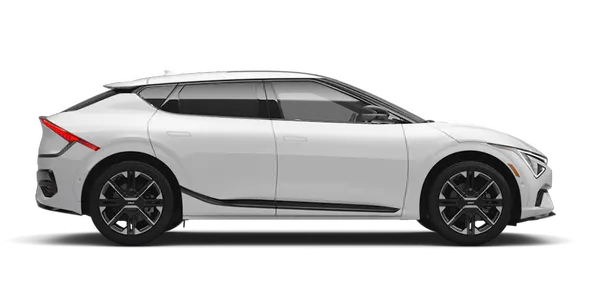
Contents
Categories
- Manuals Home
- Kia EV6 Owners Manual
- Questions & Answers
- Video Guides
- Useful Resources
- New on site
- Most important about Kia EV6
- Privacy Policy
