
Kia EV6: Smart Cruise Control malfunction and limitations / Limitations of Smart Cruise Control
Under the following conditions, Smart Cruise Control on the Kia EV6 may operate abnormally, react later than expected, or function differently from normal operation. Drivers should always remain alert and avoid relying entirely on automated assistance systems.
-
The detection sensor or surrounding sensor area is contaminated, obstructed, damaged, or covered with dirt, snow, water, ice, or road debris.
-
Windshield washer fluid is continuously sprayed or the windshield wipers are operating for an extended period.
-
The front camera lens is blocked by windshield tint, protective film, coatings, damaged glass, condensation, stickers, dirt, insects, or other foreign objects attached to the windshield.
-
Moisture, frost, snow, or ice is present on the windshield in front of the camera.
-
Strong sunlight or glare interferes with the front view camera’s field of vision.
-
Streetlights, headlights, or reflected light from wet pavement or puddles interfere with sensor visibility.
-
The temperature around the Kia EV6 front camera is extremely high or extremely low.
-
An object placed on the instrument panel reflects onto the windshield or obstructs the camera.
-
The surrounding environment is excessively bright.
-
The surrounding environment is very dark, such as when driving inside tunnels or poorly illuminated areas.
-
The brightness level changes suddenly, for example when entering or exiting a tunnel.
-
Outside visibility is poor and the headlights are not turned ON or are not bright enough for safe detection.
-
You are driving in heavy rain, snowstorms, blizzards, dense fog, or severe weather conditions.
-
Steam, smoke, shadows, or airborne particles interfere with sensor detection.
-
Only part of the vehicle ahead can be detected by the sensors.
-
The vehicle ahead has unusual, damaged, missing, or modified tail lamps.
-
Ambient brightness is low and the vehicle ahead does not have illuminated tail lights.
-
The rear shape of the vehicle ahead is unusual, tilted, overturned, heavily loaded, or visually distorted.
-
The vehicle ahead has extremely low or high ground clearance.
-
A nearby vehicle suddenly cuts into your lane without sufficient warning distance.
-
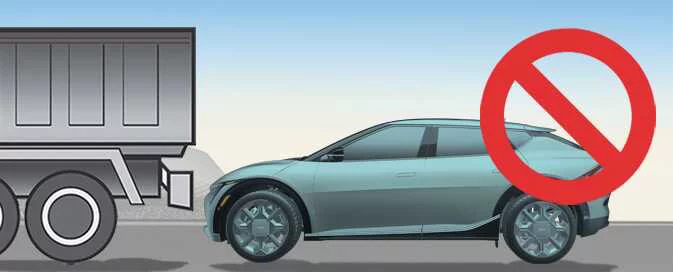
Your Kia EV6 is being towed or transported.
-
Objects such as guardrails, metallic barriers, nearby vehicles, or reflective surfaces interfere with front radar signals.
-
The bumper area near the front radar has been impacted, damaged, repaired incorrectly, or the radar position has shifted.
-
The temperature near the front radar sensor is excessively hot or cold.
-
The vehicle ahead is made from materials that poorly reflect radar signals.
-
You are driving on slippery roads covered by water, snow, slush, mud, or ice.
-
You are driving on a sharp curve or winding mountain road.
-
The Kia EV6 detects the vehicle ahead later than expected due to road curvature or environmental interference.
-
The vehicle ahead suddenly becomes hidden behind another object or obstacle.
-
The vehicle ahead changes lanes suddenly or rapidly decreases speed.
-
The vehicle ahead has an irregular or heavily damaged shape.
-
The front vehicle is moving at an unusually high or unusually low speed.
-
While following another vehicle, your Kia EV6 suddenly changes lanes at low speed.
-
The vehicle ahead is heavily covered with snow, mud, or dirt.
-
Your driving pattern becomes unstable because of road conditions or sudden steering corrections.
-
You are driving through a traffic circle where the road curvature prevents accurate vehicle detection.
-
You are continuously driving in circular patterns or around curved ramps.
-
Poor road conditions create excessive vibrations that affect Smart Cruise Control sensor operation.
-
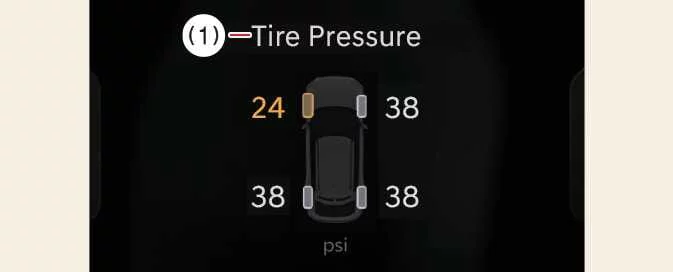
Your Kia EV6 ride height changes because of heavy cargo, towing load, uneven weight distribution, or incorrect tire pressure.
-
Driving in the following environments:
-
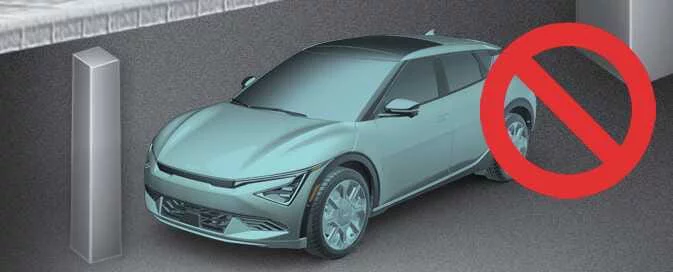
Inside parking lots or parking structures.
-
Driving through construction zones, unpaved surfaces, partially paved roads, rough terrain, potholes, or speed bumps.
-
Driving on steep, winding, or sharply curved roads.
-
Driving near roadside trees, poles, or streetlights.
-
Driving on narrow roads surrounded by dense vegetation or overgrown trees.
-
Driving near strong electromagnetic sources, radio towers, or electrical interference.
-
Driving on sloped roads, curved exits, or uneven surfaces.
-
Driving through tunnels, underpasses, or steel bridges.
-
Driving near construction areas, railroads, or locations with large amounts of metal.
-
Driving in wide open areas such as deserts, meadows, or suburban zones with few structures or vehicles.
-
Driving near highway interchanges, toll plazas, or complex roadway junctions.
-
-
You are driving on a curved road.
While driving through curves, Smart Cruise Control in the Kia EV6 may temporarily fail to detect a vehicle traveling in the same lane and may accelerate toward the preset speed. Vehicle speed may then decrease suddenly once the vehicle ahead becomes detectable again.
Select an appropriate speed before entering curves, and use the brake pedal or accelerator pedal according to traffic flow and road conditions ahead.
Your Kia EV6 speed may be reduced because the system reacts to a vehicle traveling in a nearby lane.
Always confirm that road and traffic conditions allow safe use of Smart Cruise Control, and apply the brake pedal if necessary to maintain a safe following distance.
-
Driving on an incline
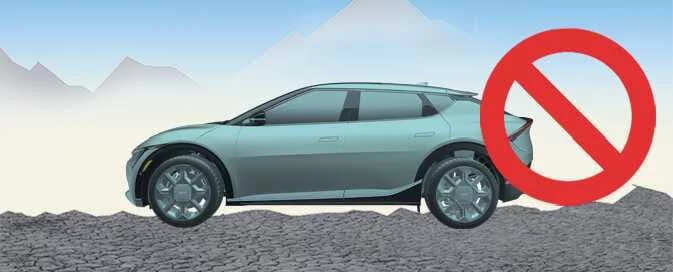
When driving uphill or downhill, Smart Cruise Control may not immediately detect vehicles traveling ahead in your lane, which can cause the Kia EV6 to accelerate toward the set speed unexpectedly. Once a vehicle is detected again, vehicle speed may decrease rapidly.
Always select a safe speed for steep inclines and use the brake pedal or accelerator pedal as needed depending on road and traffic conditions.
-
Changing lanes
-
Your vehicle
-
Lane changing vehicle
When another vehicle (2) enters your lane from a neighboring lane, the Smart Cruise Control sensors of the Kia EV6 may not detect it immediately until the vehicle moves fully into the radar detection area. If another driver changes lanes abruptly, you must manually maintain a safe braking distance.
If necessary, press the brake pedal to reduce speed and maintain a safe distance from surrounding traffic.
-
-
Detecting a vehicle
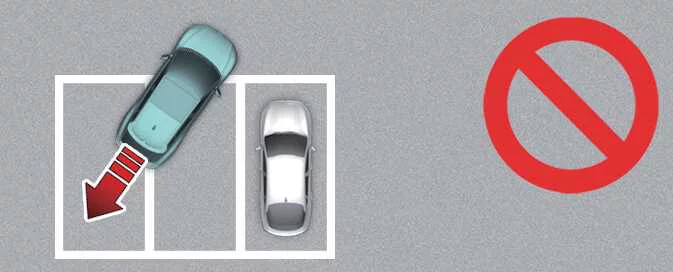
The sensor system in the Kia EV6 may have difficulty detecting the following vehicles, objects, or road users:
-
Vehicles positioned partially outside the lane.
-
Slow-moving vehicles or vehicles braking suddenly.
-
Vehicles with unusually high ground clearance or loads extending from the rear.
-
Vehicles with the front end raised due to heavy cargo.
-
Vehicles traveling within approximately 2 m (6 ft.) of your Kia EV6.
-
Oncoming vehicles traveling in the opposite direction.
-
Stopped vehicles or stationary obstacles.
-
Vehicles with a narrow rear profile such as trailers.
-
Narrow vehicles including motorcycles, bicycles, scooters, or other two-wheel vehicles.
-
Special-purpose vehicles or unusual transport equipment.
-
Animals, pedestrians, or small roadside objects.
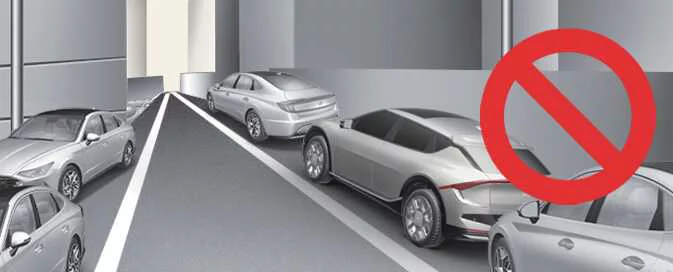
Always monitor the road, surrounding vehicles, and traffic conditions while driving the Kia EV6. If necessary, manually reduce vehicle speed or apply the brakes to maintain safe operation.
The sensor may not properly detect the vehicle ahead in the following situations:
-
You are actively steering or making sudden steering corrections.
-
You are driving on narrow roads, mountain roads, or sharply curved road sections.
-
-
When a vehicle ahead disappears at an intersection
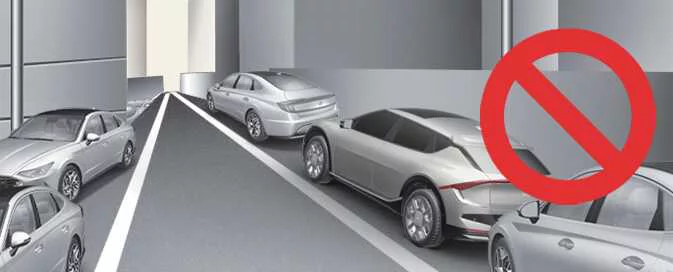
When a vehicle ahead moves away or disappears at an intersection, the Kia EV6 may accelerate automatically toward the preset speed.
Always observe the road ahead carefully and remain prepared to brake if necessary.
-
When a vehicle ahead of you changes lanes
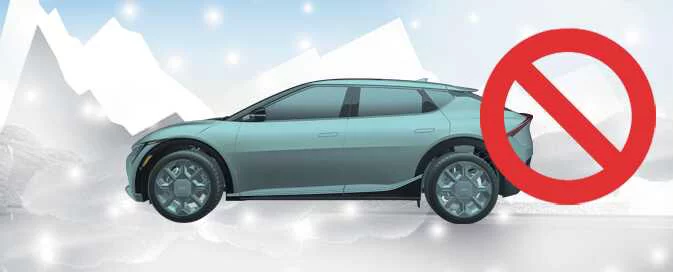
When the vehicle ahead changes lanes, Smart Cruise Control in the Kia EV6 may not immediately recognize the next vehicle that becomes positioned ahead of you.
Always pay close attention to surrounding traffic and changing road conditions.
-
Always look out for pedestrians
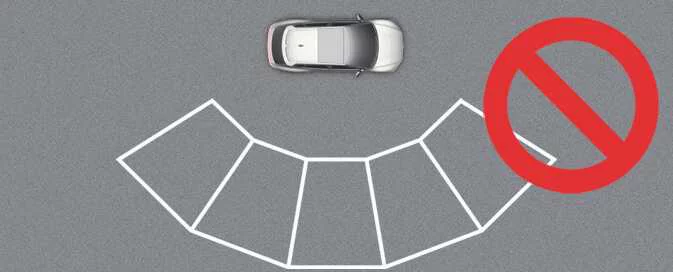
Always watch carefully for pedestrians, cyclists, animals, and unexpected obstacles whenever your Kia EV6 is maintaining a preset distance from the vehicle ahead using Smart Cruise Control.


Other information:
Kia EV6 2022-2026 Owner's Manual: Intelligent Speed Limit Assist (ISLA) : (if equipped)
The Kia EV6 Intelligent Speed Limit Assist (ISLA) system uses information detected from road signs together with navigation system data to inform the driver of the current speed limit and help maintain vehicle speed within the legal limit. The Kia EV6 ISLA system can help improve driving awareness, reduce speeding, and support safer driving habits on highways, urban roads, and speed-controlled areas.The Kia EV6 Junction Crossing, Lane-Change Oncoming, Lane-Change Side, and Evasive Steering Assist systems may experience reduced performance when the temperature around the front or rear side radar sensors becomes excessively high or low. Installing a trailer, bicycle carrier, cargo carrier, or other accessory near the Kia EV6 rear corner radar may interfere with sensor operation and limit driver assistance performance.
Categories
- Manuals Home
- Kia EV6 Owners Manual
- Questions & Answers
- Video Guides
- Useful Resources
- New on site
- Most important about Kia EV6
- Privacy Policy
