Kia K4: Smart Cruise Control operation / Limitations of Smart Cruise Control
While the Smart Cruise Control (SCC) system in your Kia K4 is engineered to provide an advanced and comfortable driving experience, its performance can be significantly affected by external environmental factors, sensor conditions, and specific driving scenarios. Please be aware that the Smart Cruise Control may operate abnormally or unexpectedly under the following circumstances:
- The front detection sensor or the areas immediately surrounding it are contaminated, covered by debris, or physically damaged.
- Washer fluid is being continuously sprayed onto the windshield, or the windshield wipers are currently in operation, obstructing the camera's field of view.
- The forward-facing camera lens is obscured by unauthorized windshield tinting, protective films, aftermarket coatings, cracked or damaged glass, or physical obstructions such as stickers, mud, or insects.
- Accumulated moisture, condensation, or ice is present on the windshield, impeding the camera’s ability to "see" the road ahead.
- Extreme solar glare, particularly during sunrise or sunset, temporarily blinds or obstructs the field of view of the Kia K4 front-facing camera.
- Streetlights, neon signs, or the headlamps of oncoming vehicles create bright reflections on wet or flooded road surfaces.
- The ambient temperature surrounding the front-view camera module is excessively high or extremely low.
- Loose objects placed on the instrument panel (dashboard) create reflections on the windshield that interfere with the camera.
- Surrounding lighting conditions are either excessively bright or too dark for the sensor array to process depth and distance effectively.
- Rapid transitions in lighting intensity occur, such as when your Kia K4 enters or exits a tunnel or covered parking structure.
- Nighttime driving conditions where the ambient light is low and your headlights are either OFF or lack sufficient brightness to illuminate the path for the sensors.
- Driving through adverse weather events, including heavy rainfall, dense snowfall, or thick, opaque fog.
- Driving through obstacles that reduce visibility, such as industrial steam, dense smoke, or deep, shifting shadows.
- The system only detects a partial profile of the vehicle traveling ahead.
- The vehicle ahead is missing functional tail lights, or the tail lights are positioned in an atypical or non-standard location.
- Low-light conditions where the vehicle ahead does not have its tail lights illuminated, or they are too dim for the sensors to track.
- The rear profile of the lead vehicle appears abnormal or small to the sensors (e.g., a tilted, overturned, or partially loaded vehicle).
- The vehicle ahead has unusually low or high ground clearance, making it difficult for the Kia K4 radar to maintain a stable lock.
- A vehicle suddenly swerves or cuts into your lane at a close distance.
- Your Kia K4 is currently being towed by another vehicle.
- Strong reflections from external objects, such as metallic guardrails, traffic signs, or nearby vehicles, interfere with the front radar signal.
- The front bumper area near the radar sensor has sustained impact damage, or the sensor has been knocked out of its factory-calibrated position.
- The ambient temperature directly surrounding the front radar module is outside of the optimal operational range.
- The lead vehicle is constructed from materials that possess low radar-reflectivity properties.
- Driving near complex infrastructure, such as multi-level highways, complex interchanges, or electronic tollgate systems.
- Navigating on low-friction road surfaces, such as those covered in packed snow, black ice, or deep standing water.
- Driving on roads with tight, winding curves that exceed the sensor's lateral detection angle.
- The system experiences a delay in identifying a vehicle ahead, or the vehicle ahead is suddenly obscured by a physical obstacle (like a median).
- The lead vehicle performs an abrupt lane change or a sudden, dramatic reduction in speed.
- The lead vehicle's body shape is irregular, bent, or distorted.
- The lead vehicle is traveling at an unusually high or very slow speed compared to your Kia K4.
- You execute an aggressive or sudden lane change while a vehicle is positioned ahead of you.
- The lead vehicle is heavily covered in snow, which hides its shape and reflectivity.
- Your current driving behavior is erratic or unstable, complicating the system's ability to maintain a steady following distance.
- Driving through a traffic circle (roundabout) where the sensors may struggle to maintain a lock on a single target vehicle.
- Continuously navigating in a circular path.
- Excessive vibration of your Kia K4 caused by severely damaged or unpaved road surfaces.
- Abnormal vehicle ride height caused by extreme heavy cargo loads, significantly incorrect tire pressure, or suspension modifications.
- Driving in specific environments including:
- Inside a parking garage or congested parking lot.
- Through active construction zones, unpaved terrain, partially paved tracks, highly uneven roads, or over severe speed bumps.
- Driving on roads with steep inclines or declines that affect the sensor's vertical detection range.
Additionally, the Smart Cruise Control (SCC) system in your Kia K4 may experience detection challenges in the following specific environmental and road conditions:
- On roads with steep gradients or sharp curves.
- When driving along roadsides lined with dense trees, utility poles, or numerous streetlights that may confuse sensor focus.
- On narrow roads characterized by overgrown foliage or tight vegetation.
- In areas with high levels of electromagnetic interference, such as near high-voltage power lines, powerful radio transmitters, or areas with significant electrical noise.
- When driving through long tunnels or enclosed bridges where lighting and radar reflections change rapidly.
- In proximity to heavy metal concentrations, such as active construction zones, railroad crossings, or road segments covered with metal plates.
- In vast, open areas where there are very few vehicles or structures for the sensors to lock onto.
-
Driving on a curved road
When navigating curves, the Kia K4 Smart Cruise Control system may briefly lose detection of a vehicle in your lane, potentially causing the Kia K4 to accelerate toward your previously set speed. Conversely, if a vehicle ahead is detected suddenly as the curve straightens, the vehicle speed may decrease rapidly. Always manually select an appropriate cruising speed for the curve and be ready to engage the brake or accelerator pedal to maintain optimal control of your Kia K4. Furthermore, the SCC may inadvertently reduce your speed due to the presence of a vehicle in an adjacent lane. Ensure that the prevailing road conditions permit safe usage of the cruise system; if you feel uncomfortable, take manual control immediately.
-
Driving on an inclined road
When driving uphill or downhill, the Kia K4 may have difficulty detecting a moving vehicle in your lane, which might cause the Kia K4 to accelerate to your set limit. If the system suddenly identifies a vehicle ahead, the speed will decrease sharply. We recommend adjusting your set speed based on the grade of the incline and the current traffic density to ensure the smoothest performance of your Kia K4.
-
Changing lanes
- Your vehicle
- Lane changing vehicle
When a vehicle merges into your lane from an adjacent one, the Kia K4 sensor cannot detect it until it has entered the active detection range. If the vehicle cuts in abruptly, the Smart Cruise Control might not react immediately. As the driver of the Kia K4, it is your responsibility to maintain a safe braking distance and engage the brake pedal whenever a rapid lane change occurs to avoid an collision.
-
Detecting a vehicle
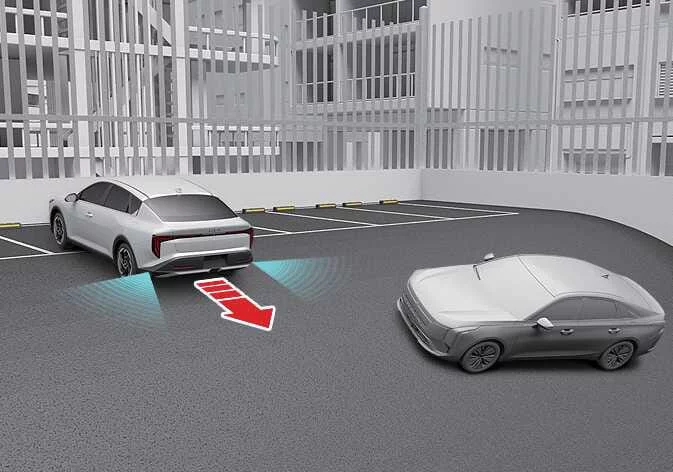
The Kia K4 uses sophisticated sensors to maintain a consistent distance; however, detection accuracy depends on the size, reflectivity, and movement pattern of the lead vehicle. Always remain vigilant and prepared to override the system if the Kia K4 does not correctly identify a target vehicle.
The sensor system in your Kia K4 is designed to assist with cruising, but it is important to understand its technical limitations. The Smart Cruise Control (SCC) sensor may fail to accurately detect the following types of vehicles or objects:
- Vehicles that are driving offset to one side of your lane.
- Vehicles that are slow-moving or have performed a sudden, aggressive deceleration.
- Vehicles with high ground clearance, or those transporting oversized loads that protrude significantly from the rear.
- Vehicles with the front chassis lifted due to excessive cargo weight, which changes their radar reflectivity profile.
- Objects or vehicles situated within approximately 6 ft (2m) of the Kia K4, which is often within the system's "blind spot" for front detection.
- Oncoming traffic in the opposite lane.
- Stationary vehicles that are not detected during the initial movement phase.
- Vehicles with a very small rear profile, such as compact utility trailers.
- Narrow vehicles, including motorcycles, bicycles, or small motorized scooters.
- Specialty vehicles with non-standard body shapes.
- Living beings, such as animals, and all pedestrians.
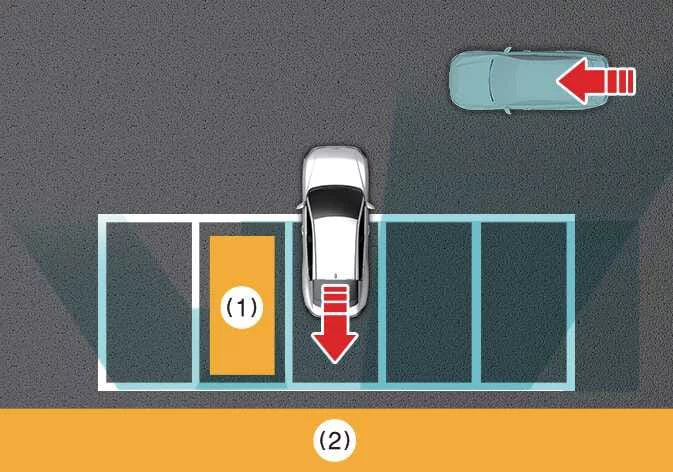
|
Always maintain full situational awareness of the road and prevailing driving conditions, and be prepared to take manual control of your Kia K4. The SCC sensor may also fail to detect a vehicle ahead in the following scenarios:
- When you are actively steering your Kia K4.
- When you are navigating through narrow corridors or on sharply curved road segments.
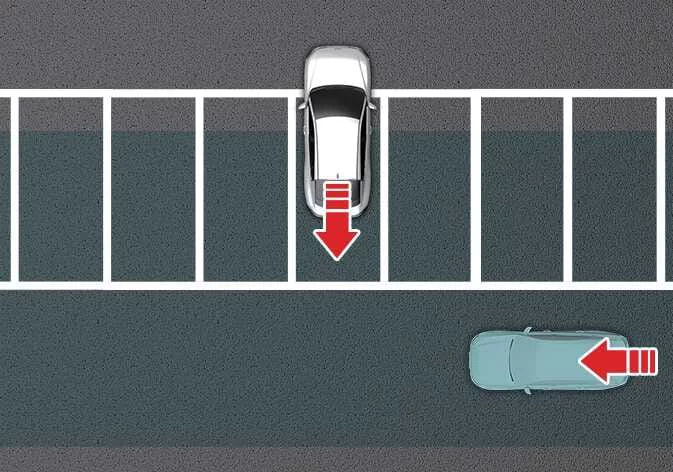
When a vehicle ahead disappears from view at an intersection
|
If the vehicle you are following turns away at an intersection, the Kia K4 may interpret this as an open road and begin to accelerate toward your set speed. Always stay vigilant and keep your foot near the brake pedal when approaching intersections in your Kia K4.
When a vehicle ahead of you changes lanes
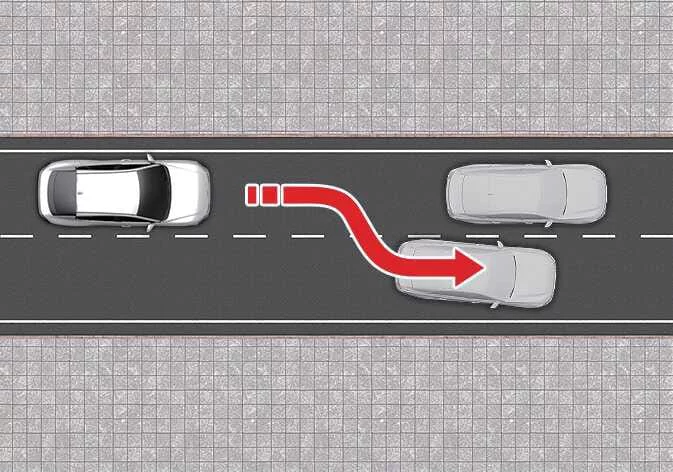
|
When a lead vehicle exits your lane, the Kia K4 system may experience a momentary delay before it identifies and locks onto a new vehicle that has merged ahead of you. During this transition, the vehicle might accelerate; always pay close attention to the road and surrounding traffic flow.
Always look out for pedestrians
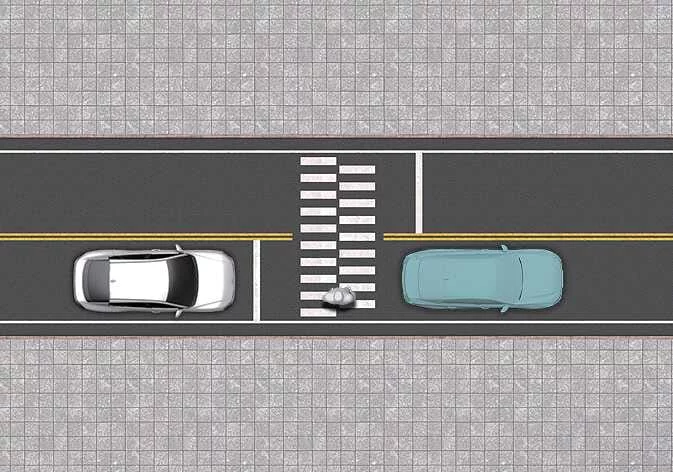
|
While your Kia K4 is maintaining a set distance from a vehicle ahead, the sensors are primarily focused on vehicle-to-vehicle tracking. It is vital to consistently scan the road for pedestrians or cyclists, as the cruise system may not prioritize them in the same manner as a lead vehicle.


Other information:
Kia K4 (CL4) 2025-2026 Owner's Manual: Over-The-Air (OTA) software update
The Over-The-Air (OTA) software update feature provides a seamless way to keep your Kia K4 performing at its peak. By wirelessly downloading the latest firmware and system improvements, this feature ensures that your Kia K4 always benefits from the most recent technological enhancements without requiring a visit to a service center. To utilize these convenient remote updates, you must maintain an active Kia Connect subscription.Kia K4 (CL4) 2025-2026 Owner's Manual: Driver Attention Warning (DAW)
Driver Attention Warning function The Driver Attention Warning (DAW) system in your Kia K4 continuously monitors your driving patterns, vehicle stability, and inputs. When the system detects signs of reduced alertness or potential fatigue, the Kia K4 will proactively recommend a rest break to ensure your continued safety on the road. Leading Vehicle Departure Alert function The Leading Vehicle Departure Alert (LVDA) is a convenient feature for the Kia K4 that provides an audible and visual notification to the driver when the vehicle ahead of you begins to move from a stationary position, such as at a traffic light or in stop-and-go traffic.