Kia K4: Forward Collision-Avoidance Assist malfunction and limitations / Limitations of Forward Collision-Avoidance Assist
While the Forward Collision-Avoidance Assist (FCA) system is designed to enhance safety in your Kia K4, its operational effectiveness can be impacted by complex traffic dynamics and environmental surroundings. Understanding these boundaries is essential for the responsible operation of your Kia K4.
The operational range and responsiveness of the system may decrease depending on the behavior of vehicles ahead and the surrounding driving environment. When driving at night or in low-light conditions, the system's ability to accurately detect vehicles, motorcyclists, pedestrians, and cyclists is reduced. Consequently, the Kia K4 Forward Collision-Avoidance Assist system may be temporarily limited or fail to trigger.
Performance may also be affected by vehicle positioning: if either your Kia K4 or an oncoming vehicle is not traveling in a straight path, the Front Oncoming function may experience delays or fail to activate. Similarly, if the angle of a potential collision with a crossing vehicle is outside the system's calibrated range, the Junction Crossing warning and control features may not engage as intended.
Regarding Emergency Steering and Evasive Steering Assist in the Kia K4, these functions will automatically conclude once the detected risk factors disappear. If you hold the steering wheel tightly or attempt to steer in the opposite direction during an intervention, the system may deactivate. Furthermore, to maintain vehicle stability, Evasive steering assist will deactivate if the system predicts a secondary collision with other nearby obstacles. These steering features may also be unavailable if the Kia K4 calculates that there is insufficient lateral space to execute a safe avoidance maneuver.
It is important to note that the Kia K4 Forward Collision-Avoidance Assist does not activate for carts, bicycles, or other objects being pushed or pulled by people. Additionally, the system may suffer from performance issues if exposed to strong electromagnetic interference. Please be aware that the system requires an initialization period of approximately 15 seconds after you start the engine or initialize the front view camera.
The Forward Collision-Avoidance Assist in your Kia K4 may operate abnormally or unexpectedly under the following conditions:
-
A sensor is obscured by debris, mud, or damaged due to a collision.
-
The operating temperature around the front-view camera is outside the recommended range.
-
The camera lens is obstructed by unauthorized windshield tinting, film, aftermarket coatings, stickers, or persistent insect buildup.
-
There is moisture, condensation, or ice buildup on the windshield.
-
Visibility is severely limited by heavy rain, snowfall, or dense fog.
-
Direct glare from the sun obstructs the field of view of the front camera.
-
Light reflects intensely off wet road surfaces, such as large puddles.
-
Loose objects are placed on the instrument panel that may interfere with sensor views.
-
The environment is excessively bright or dark, complicating image processing.
-
Rapid changes in lighting occur, such as entering or exiting tunnels.
-
Driving in dark conditions without headlights, or with headlights that are obscured.
-
A vehicle, motorcyclist, pedestrian, or cyclist is only partially visible to the sensors.
-
The vehicle ahead is a large bus, heavy truck, or a vehicle towing a trailer/bulky cargo.
-
The target vehicle or motorcyclist has non-standard tail light configurations or missing rear lights.
-
The ground clearance of the vehicle in front is abnormally high or low.
-
A pedestrian or vehicle suddenly darts or crosses directly ahead of your Kia K4.
-
The front radar sensor is misaligned or physically damaged.
-
The temperature near the front radar exceeds its normal operating threshold.
-
Driving in isolated areas with very few structures or vehicles, such as deserts or open meadows, which reduces the system's ability to reference objects.
-
You are driving near areas with significant metallic infrastructure, such as active construction zones, railroad crossings, or roads featuring metal plating, which can disrupt the radar signals of your Kia K4.
-
Shadows cast across lane markings by median strips, dense trees, guardrails, or noise barriers may interfere with the camera's ability to track the Kia K4 path correctly.
-
The clear line of sight to a vehicle or motorcyclist ahead is suddenly obscured by another object or sudden turn.
-
The vehicle or motorcyclist ahead performs an erratic maneuver, such as an abrupt lane change or rapid deceleration.
-
The target vehicle ahead is heavily covered in snow or mud, making it difficult for the Kia K4 sensor suite to distinguish the object's shape.
-
You are in the process of departing from or merging back into your lane.
-
The vehicle's driving trajectory is unstable due to road conditions or driver inputs.
-
You are navigating a traffic circle where the curvature of the road prevents the sensors from maintaining a lock on the vehicle or motorcyclist ahead.
-
Driving on steep hills or severe inclines may temporarily place the vehicle or motorcyclist ahead outside the effective detection range of the Kia K4 camera or radar systems.
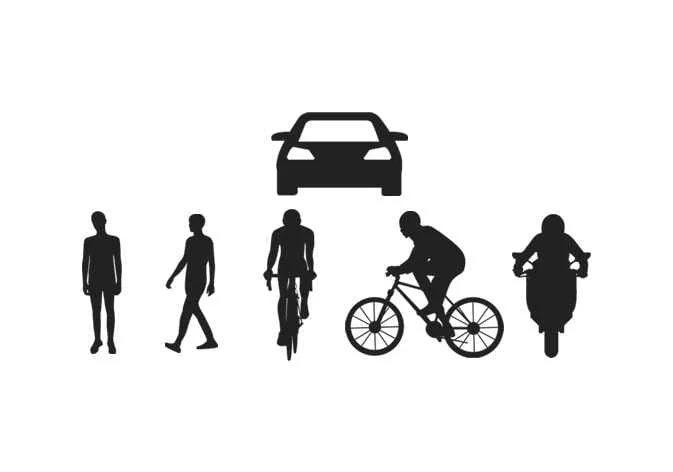
The following illustration depicts the typical profiles of vehicles, motorcyclists, pedestrians, and cyclists that the front-view camera and front radar in your Kia K4 are designed to detect:
|
The system may fail to identify a pedestrian or cyclist ahead if they are:
Leaning over, crawling, or otherwise not walking in a fully upright, expected posture.
Wearing specialized clothing, bulky gear, or reflective equipment that obscures their human silhouette.
Moving across the path of the Kia K4 at an exceptionally high velocity.
Of a small stature, such as a young child or a person in a crouching position.
Moving against the standard flow of traffic or utilizing a mobility aid that alters their expected movement pattern.
Comprising a part of a large, dense crowd, making individual detection difficult.
Camouflaged or otherwise difficult to distinguish from the surrounding environment or background.
Detection of pedestrians, motorcyclists, or cyclists may be compromised when your Kia K4 is:
Driving through steam, heavy industrial smoke, or deep shadows.
Passing through tunnels or crossing steel bridges that generate interference.
In large, open areas with minimal infrastructure, such as deserts, expansive fields, or rural meadows, where there are few reference points.
Navigating within a crowded parking lot.
Traversing through tollgates, active construction sites, or extremely rough/bumpy terrain.
Passing areas with high concentrations of metal, such as industrial zones or railroad lines.
Traveling on exceptionally steep or sharp, curving roads.
Driving alongside roads lined with dense trees or frequent street light posts.
Navigating narrow roads bounded by dense overgrowth or thick forests.
Subjected to high levels of electromagnetic interference, such as areas with powerful radio transmitters or localized electrical noise.
Operating with non-standard equipment, such as snow chains, a temporary spare tire, or mismatched wheel sizes.


Other information:
Kia K4 (CL4) 2025-2026 Owner's Manual: Lane Keeping Assist (LKA)
When operating your Kia K4 at speeds above a certain threshold, the Lane Keeping Assist (LKA) system actively monitors road lane markings and edges. Designed to enhance your driving experience, Lane Keeping Assist can provide proactive steering assistance to help prevent your Kia K4 from unintentionally drifting out of its lane. Furthermore, the system is engineered to provide an alert if it detects that the vehicle is departing from its lane without the driver engaging the turn signal.Kia K4 (CL4) 2025-2026 Owner's Manual: High Beam Assist (HBA)
The High Beam Assist (HBA) feature in your Kia K4 provides automated convenience by switching between high and low beams based on the detection of oncoming vehicles, preceding taillights, and ambient road brightness. This helps maximize your vision without blinding other road users. Detection sensor The system relies on a high-resolution forward-facing camera.